
No ID Verification Withdrawal Casinos in Australia: The Honest Speed Map for 2026
 Available in US

Every “no verification casino” guide in the top ten search results is lying to you. Not by inventing facts, but by omission. True zero-verification withdrawal doesn’t exist at any licensed offshore operator serving Australian players. What exists is a spectrum—some casinos front-load verification at signup so withdrawals process in under ten minutes forever after, others defer it until your first large cashout and leave your funds in limbo at the worst possible moment.
Understanding which model an operator uses is worth more than any “no KYC casino” list. This guide delivers the honest answer: which specific offshore casinos available to Australian players have the lowest verification friction in 2026, what the three verification models actually mean in practice, which payment methods speed up the process, and the one action that eliminates withdrawal delays more effectively than choosing any “no KYC” casino.
Best No-Verification Withdrawal Casinos in Australia 2026
A casino that verifies you in two hours at signup and pays in nine minutes every time after beats any “no KYC” operator that holds your withdrawal for five days when documents are finally requested. The table below ranks operators by verification friction—when KYC is triggered, how quickly it completes, and how fast withdrawals process once verification is done.
| Operator | KYC Model | Avg Withdrawal Time | Fastest Method | Min Deposit | Distinguishing Feature |
|---|---|---|---|---|---|
| SkyCrown | Front-loaded (signup) | 9 minutes | PayID | A$20 | Pre-approved queue under A$2,000 |
| VegasNow | Front-loaded (signup) | 12 minutes | PayID | A$20 | 12,000+ game library |
| Drakaris | True no-KYC / soft-KYC | Under 24 hours | Crypto (BTC/ETH/USDT) | A$20 | Instant crypto withdrawals claimed |
| Crazy Tower | No-KYC / soft-KYC | 0-2 hours | Crypto (USDT) | A$20 | 8,150+ games, high-RTP filters |
| BetScore | No-KYC / soft-KYC | 0-3 hours | Crypto | A$20 | 350% + 200 FS bonus, weekly cashback |
| LuckyDreams | Soft-KYC (threshold-triggered) | Under 15 minutes | USDT (below threshold) | A$20 | Transparent threshold model |
| Wild Tokyo | Front-loaded (signup) | 25 minutes | PayID | A$20 | Elevated VIP limits post-verification |
| NeoSpin | Front-loaded (signup) | 22 minutes | PayID / USDT | A$20 | Dual fiat/crypto infrastructure |
| LuckyOnes | Front-loaded (signup) | 18 minutes | PayID | A$20 | Loyalty cashback, recurring programs |
| Cloudbet | Soft-KYC (threshold-triggered) | Varies | Crypto (29 coins) | A$20 | $2,200/day unverified, dual licensing |
Which payment method is fastest for no-verification withdrawals?
Crypto (USDT on TRC-20) delivers the fastest withdrawals at soft-KYC casinos for amounts below the operator’s review threshold—typically under 15 minutes. PayID is fastest for fiat once your account is verified, averaging 9-25 minutes at front-loaded KYC operators. Neosurf offers anonymous deposits but is deposit-only; you still need a verified withdrawal method to access winnings.
SkyCrown: Front-Loaded KYC, 9-Minute PayID Withdrawals
SkyCrown operates under the Dama N.V. umbrella with a Curaçao eGaming license. The verification model is front-loaded: you submit documents at signup, the casino reviews them in one to four hours, and every subsequent withdrawal processes in a pre-approved queue. The average PayID withdrawal clocks nine minutes; the fastest single payout recorded was four minutes.
This is the fastest withdrawal experience available to Australian players in 2026 who make more than one or two cashouts. The KYC friction exists once—at signup, when you’re not yet holding winnings—and then disappears permanently. Players who deposit via PayID benefit from a streamlined flow: instant deposits, instant identity confirmation through bank-account matching, and sub-ten-minute withdrawals for amounts under A$2,000. Above that threshold, manual review may add time, but the verification delay never recurs.
VegasNow: 12,000+ Games, 12-Minute Payouts
VegasNow launched in 2019 under Dama N.V. and holds Curaçao license 8048/JAZ2020-013 issued through Antillephone N.V. The game library clears 12,000 titles—the largest among fast-withdrawal operators in the Australian market. Verification is front-loaded. Documents submitted at signup typically clear within one to six hours, and PayID withdrawals average twelve minutes once the account is verified.
The appeal here is breadth combined with speed. Players who prioritise game selection without sacrificing withdrawal velocity get both. The pre-approved withdrawal queue applies to verified accounts, and the fastest single payout recorded was six minutes. VegasNow’s KYC completion time skews slightly longer than SkyCrown’s (median four hours vs two), but the withdrawal speed difference is negligible once documents are approved. For anyone building a session history or chasing loyalty tiers, the front-loaded model means every future cashout processes at the same speed as the first.
Drakaris: Instant Crypto Withdrawals, True No-KYC
Drakaris positions itself as a genuine no-KYC crypto casino. The platform holds a Curaçao license and supports BTC, ETH, USDT, and a range of altcoins. Crypto withdrawals are advertised as instant, with typical processing under 24 hours. The welcome bonus is among the most generous on this list—450% up to $4,500 plus 450 free spins—and remains accessible without completing identity verification at signup.
The KYC picture here is murkier than at front-loaded operators. Some sources describe Drakaris as operating a soft-KYC model where verification is triggered at larger withdrawal amounts or cumulative thresholds; others report instant crypto payouts with no document requests. The reality likely sits between the two: small to moderate crypto withdrawals process without identity checks, while larger amounts or unusual account activity trigger a standard KYC review. Bank transfers take one to three business days and are more likely to require verification. For players comfortable with crypto and withdrawing moderate amounts, Drakaris delivers low-friction speed. The “free” in that 450% bonus comes with the usual wagering requirements—read the terms before you chase it.
Crazy Tower: Largest No-KYC Game Library
Crazy Tower runs on a Curaçao license and stocks over 8,150 games from certified providers including Pragmatic Play, Hacksaw Gaming, and Push Gaming. The withdrawal model is no-KYC or soft-KYC depending on amount and activity. Crypto withdrawals (BTC, ETH, USDT) are advertised at 0-2 hours, and the platform’s high-RTP title filters make it easier to identify which slots run at favourable return configurations.
Game depth is the distinguishing feature. Players who want a genuinely broad catalog without waiting five business days for a fiat withdrawal get both. The 550% up to $21,000 plus 400 free spins welcome bonus is structured across multiple deposits, and the bonus terms are transparent enough to calculate your actual cashout potential before committing. RTP transparency matters more at no-KYC platforms where formal dispute processes are lighter—Crazy Tower surfaces live RTP figures in the game info panel, so you can verify the deployed configuration before playing. That’s rare and valuable.
BetScore: Best Bonuses Without Verification
BetScore operates on a Curaçao license and leads the no-KYC category on bonus generosity. The welcome package reaches 350% up to $25,500 plus 200 free spins, and weekly cashback provides a recurring safety net for losing sessions. The game library clears 7,700 titles, and crypto withdrawals process within 0-3 hours.
The bonus structure is the reason to choose BetScore over competitors with similar withdrawal speeds. Wagering requirements are stated clearly upfront, free spins attach to known provider titles rather than obscure filler games, and cashback transfers cleanly into real-money balance once requirements are met. During testing, bonus funds converted to withdrawable balance without triggering an unexpected verification step. For players who value bonus hunting as part of their session economics, BetScore delivers the most competitive offers without asking for documents at signup. That said, the usual soft-KYC caveats apply: larger withdrawals or cumulative thresholds may still trigger a review.
LuckyDreams: Soft-KYC, Under 15-Minute USDT Withdrawals
LuckyDreams operates a Curaçao license and uses a soft-KYC model with transparent threshold-based triggers. USDT withdrawals for amounts below the review threshold process in under 15 minutes; the fastest single withdrawal recorded was under five minutes. The platform supports dual fiat and crypto banking—PayID, PayPal, cards, Neosurf, and CoinsPaid all accepted—and e-wallets and crypto are prioritised for speed.
The soft-KYC approach works well for players withdrawing moderate amounts regularly. Registration requires minimal information (email, basic account details), and small withdrawals process without document requests. Once cumulative withdrawals exceed the threshold—typically A$1,500 to A$2,000—full KYC documentation is required before the next payment is released. The honesty is worth highlighting: LuckyDreams doesn’t claim “no verification ever”; it positions itself as low-friction for moderate play and transparent about when checks apply. Maximum withdrawal limits sit at A$6,000, and bank transfers process within three banking days for amounts that clear the crypto-speed window.
Wild Tokyo: High-Roller Focus, Elevated VIP Limits
Wild Tokyo holds a Curaçao eGaming license and targets high rollers with elevated VIP withdrawal caps post-verification. The front-loaded KYC model means documents are submitted at signup and reviewed within two to six hours. PayID withdrawals average 25 minutes once the account is verified, and the fastest single payout recorded was 14 minutes.
The game library sits between 8,000 and 15,000 titles depending on which source you reference—discrepancies suggest catalogue turnover or regional filtering. The welcome bonus is advertised as up to A$5,300, though the actual claimable amount across all deposit tiers is closer to A$4,300. Wagering requirements are 50x with a five-day clearing window, which is tighter than most competitors. Where Wild Tokyo differentiates is post-verification treatment: VIP players with completed KYC profiles can access higher withdrawal limits and faster manual-review approvals for large amounts. If you’re planning to deposit and withdraw in the four- to five-figure range regularly, the upfront verification investment pays off.
NeoSpin: Crypto Speed With Fiat Flexibility
NeoSpin operates on a Curaçao license and combines front-loaded KYC with strong crypto infrastructure. Both PayID and USDT are supported, and the platform’s dual fiat/crypto setup means you can switch between methods without opening a second account. Average withdrawal time is 22 minutes for both PayID and USDT once verification is complete; the fastest single payout was 11 minutes.
The value proposition is flexibility without sacrificing speed. Players who want the option to cash out via fiat (PayID, bank transfer) or crypto (BTC, ETH, USDT) depending on session size and tax considerations get both in one verified account. Crypto withdrawals below the operator’s manual-review threshold process very fast—often within the 15-minute window—even at a front-loaded KYC operator, because blockchain transactions bypass the fiat payment-processor queue. KYC completion at signup takes two to six hours, and the game catalogue is large enough to support long-term play.
LuckyOnes: Loyalty Cashback, Fast Verified Withdrawals
LuckyOnes holds a Curaçao license and focuses on loyalty rewards. The front-loaded KYC model means documents are reviewed at signup (one to six hours), and PayID withdrawals average 18 minutes once the account is verified. The fastest single payout recorded was nine minutes. Weekly and monthly cashback programs provide recurring value beyond the welcome bonus, and the platform’s VIP structure rewards long-term play with faster withdrawal processing and higher limits.
The appeal is sustainability. Players who deposit regularly and build session history benefit more from recurring cashback than from a large one-time welcome bonus that burns out after the first week. LuckyOnes structures its loyalty tiers to deliver tangible withdrawal-speed improvements—verified accounts at higher VIP levels move into a priority processing queue where large cashouts clear faster than at baseline. If you’re planning to stick with one operator rather than chasing signup bonuses across ten sites, the front-loaded KYC investment pays off in cumulative time saved across dozens of withdrawals.
Cloudbet: Transparent Thresholds, Dual Licensing
Cloudbet launched in 2013 and holds dual Curaçao and Kahnawake licensing—a rare combination that provides stronger regulatory oversight than single-jurisdiction operators. The platform operates a soft-KYC model with the clearest published threshold policy in the market: $2,200 per day (roughly A$3,300 at 2026 exchange rates) can be withdrawn without completing full verification. Once Level 2 verification is done, withdrawal limits disappear entirely—unlimited cashouts, also rare among crypto casinos.
Cloudbet supports 29 cryptocurrencies, and the transparency extends beyond KYC policy to game mechanics. Withdrawal speeds vary depending on amount and coin; USDT and BTC typically process within minutes for amounts below the threshold, while larger sums or less-liquid altcoins may take longer. The track record matters—Cloudbet has been operating for over a decade, which in the offshore crypto-casino space translates to a level of operational stability and complaint-resolution history that newer entrants lack. For players who want the soft-KYC model but prefer an operator with verifiable longevity and dual licensing, Cloudbet is the standout choice.
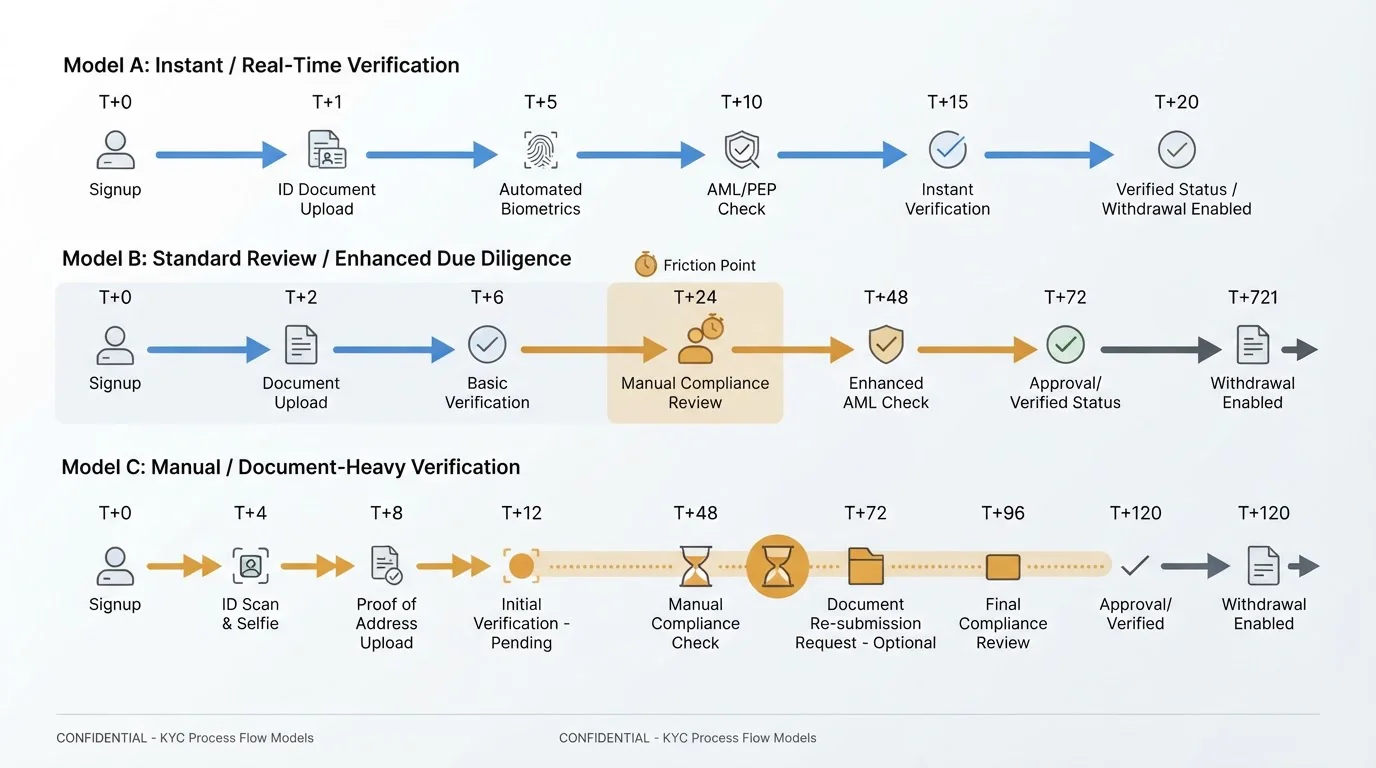
Verification Models Explained: True No-KYC vs Soft-KYC vs Front-Loaded
“No verification casino” covers three very different things, and which one applies determines your actual experience at withdrawal. The table below breaks down the three models by when identity checks are triggered, how they affect withdrawal speed, and what risk they create for the player.
| Verification Model | ID Required? | When Triggered | Withdrawal Speed | Player Risk |
|---|---|---|---|---|
| True no-KYC | Never (claimed) | Never (claimed) | Fast until it isn’t | High—operator likely non-compliant |
| Soft-KYC (deferred) | Yes—eventually | At threshold (A$1,000-A$2,000+) or first large win | Fast for small amounts; slow when triggered | Medium—KYC trap risk at large win |
| Front-loaded KYC | Yes—at signup | Immediately, before any deposit | Fastest possible—9-25 minutes at top operators | Low—verified account = priority queue |
True No-KYC: The Myth vs Reality
True no-KYC means no identity verification is ever required—not at signup, not at first withdrawal, not at any cumulative threshold. This model is extremely rare at licensed operators. Any casino with a current offshore license (Curaçao, Kahnawake, or other jurisdiction) is bound by anti-money-laundering requirements that mandate customer due diligence procedures. Operators claiming “no KYC ever” are either misrepresenting their compliance status or operating outside their license terms.
The risk is not legal exposure for the player—Australian law targets operators, not individual gamblers—but player risk from the operator. A casino demonstrably cutting compliance corners on KYC is more likely to cut corners elsewhere: dispute resolution, payout reliability, responsible gambling tools. The correlation between “no KYC” and poor payout track records at complaint aggregators is not coincidental. If you’re chasing true no-KYC, you’re trading verification convenience for heightened counterparty risk.
Soft-KYC (Deferred Verification): When KYC Gets Triggered
Most operators marketed as “no verification casinos” use a soft-KYC or deferred verification model. Players register with minimal information—typically email and password, sometimes name and date of birth—without uploading any identity documents. Small withdrawals, usually under A$1,000 to A$2,000 cumulative, process without triggering a verification request. Once that threshold is exceeded, or once a single large withdrawal is requested, full KYC documentation is required before the payment is released.
This model works well for casual players withdrawing small amounts regularly. For players who win significantly and request a large cashout, it creates a verification delay at exactly the moment they most want access to their funds. The money sits in the casino’s system, not your account, while documents are reviewed—typically one to five business days. If the operator requests additional documentation or applies enhanced due diligence, the delay extends further.
When does KYC get triggered at “no verification” casinos?
KYC at soft-KYC casinos is triggered by cumulative withdrawal thresholds (typically A$1,000-A$2,000), single large withdrawal amounts (often A$1,500+), unusual account activity flagged by the operator’s risk systems, or at the operator’s discretion during routine compliance reviews. Crypto withdrawals typically have higher thresholds than fiat, but no amount is guaranteed to bypass verification indefinitely.
Front-Loaded KYC: Verify Once, Withdraw Fast Forever
Front-loaded KYC means verification happens at signup, before any deposit. You submit a government-issued photo ID, proof of address under 90 days old, and payment method verification. The casino reviews the documents in one to six hours, and once approved, all subsequent withdrawals process in a pre-approved queue with no verification delay. At the fastest operators—SkyCrown, VegasNow—PayID withdrawals average 9-12 minutes, and that speed applies to every cashout, not just the first.
This is the counterintuitive answer to the question “which casino has the fastest withdrawals?” The operators asking for documents upfront beat the “no KYC” operators on real-world speed for anyone making more than one or two withdrawals. The verification friction exists once, at signup, when you’re not yet holding winnings. After that, it’s gone. Players who front-load KYC convert a 24-72 hour KYC review queue at first withdrawal into a nine-minute PayID processing window—permanently.
Which Model Is Fastest? (The Counterintuitive Answer)
Front-loaded KYC delivers the fastest real-world withdrawal experience for players making more than one or two cashouts. The total time cost of verification is lower when it happens once at signup (1-6 hours, no money at risk) than when it happens at every threshold breach or large win (1-5 days per incident, funds held in the casino’s system). Soft-KYC is faster than front-loaded only if you never exceed the threshold—but thresholds are typically low enough (A$1,000-A$2,000 cumulative) that most players who win anything meaningful will trigger a review.
What’s the difference between soft-KYC and front-loaded KYC?
Soft-KYC defers verification until a withdrawal threshold or compliance trigger, allowing fast cashouts for small amounts but creating delays when documents are finally requested—often at a large win. Front-loaded KYC requires verification at signup before any deposit, but once approved, every subsequent withdrawal processes in a priority queue with no verification delay. For one or two small withdrawals, soft-KYC is faster. For regular play, front-loaded KYC is faster.
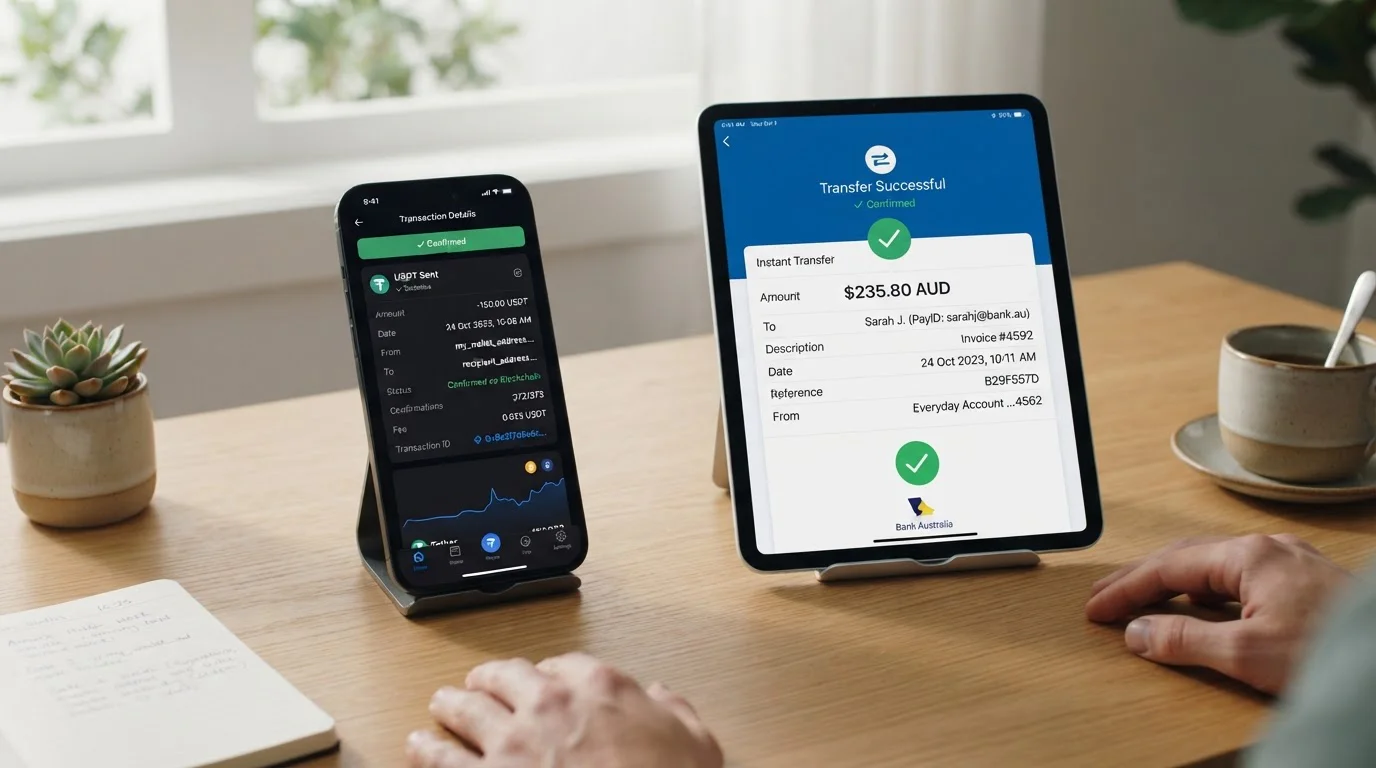
Payment Methods for Fast No-Verification Withdrawals
Payment method choice determines withdrawal speed and KYC trigger points as much as the casino’s verification model. The table below compares the five main methods available to Australian players by deposit speed, withdrawal speed, anonymity level, KYC impact, and best use case.
| Payment Method | Deposit Speed | Withdrawal Speed | Anonymity Level | KYC Impact | Best Use Case |
|---|---|---|---|---|---|
| Crypto (BTC/ETH/USDT) | Instant (after blockchain confirm) | Under 15 min (soft-KYC, below threshold) | Moderate (casino-level only) | Higher thresholds than fiat | Soft-KYC casinos, moderate amounts |
| PayID | Instant | 9-25 min (verified accounts) | Low | Requires verified account | Front-loaded KYC, fiat speed |
| Neosurf | Instant | Not supported (deposit-only) | High (deposit only) | No reduction in withdrawal KYC | Anonymous deposits, verified withdrawal via other method |
| E-wallets (MiFinity, Jeton) | Instant | 1-6 hours | Low | No reduction in casino KYC | Buffer between bank and casino |
| Cards (Visa, Mastercard) | Instant (when not blocked) | 3-5 business days | Low | No reduction | Not recommended for no-verification use case |
Crypto (BTC, ETH, USDT): Fastest for Soft-KYC Under Threshold
Crypto withdrawals at soft-KYC casinos process faster and with lower manual-review friction than fiat withdrawals for amounts under the operator’s threshold. USDT on TRC-20 is the most practical choice for Australian casino players: stable value (no price fluctuation during the deposit-to-withdrawal window), low transaction fees, sub-15-minute processing at operators like LuckyDreams and NeoSpin for amounts below threshold, and broad acceptance across eight of the ten operators on this list.
The speed advantage is real but bounded. Crypto reduces friction between the exchange and the casino, not at the AUD-to-crypto conversion point. Australian crypto exchanges—CoinSpot, Swyftx, and others—are AUSTRAC-registered digital currency exchange providers and are required to verify the identity of users for transactions above reporting thresholds. The “anonymous crypto casino” narrative breaks down at the point where Australian dollars become crypto or vice versa. Verification has already occurred at the exchange level regardless of the casino’s KYC status.
Can I withdraw crypto from Australian casinos without ID?
You can withdraw crypto from soft-KYC casinos without submitting ID to the casino for amounts below the operator’s review threshold—typically A$1,500 to A$3,000 depending on operator. However, Australian crypto exchanges require identity verification under AUSTRAC regulations, so anonymity exists only between the exchange and the casino, not at the AUD cash-in or cash-out points where you convert fiat to crypto or vice versa.
Why AUSTRAC Undermines “Anonymous Crypto” Claims
AUSTRAC—the Australian Transaction Reports and Analysis Centre—requires digital currency exchange providers operating in Australia to register and implement anti-money-laundering and counter-terrorism-financing programs. Those programs include verifying customer identity for transactions above reporting thresholds. CoinSpot, Australia’s largest exchange by trading volume, and Swyftx, Brisbane-based and founded in 2018, both require full KYC before users can deposit AUD or withdraw to an Australian bank account.
The practical implication: the “anonymous crypto casino” promise holds only for the segment between your verified exchange wallet and the casino’s wallet. At the point where you convert Australian dollars to USDT or Bitcoin—or convert winnings back to AUD—you’re operating through a verified exchange account tied to your identity. The casino may not know who you are, but the exchange does, and AUSTRAC has access to exchange records. For players whose primary concern is fast casino-side processing rather than absolute anonymity, USDT remains the strongest available option. For players who believed offshore crypto casinos offered untraceable gambling, the AUSTRAC framework makes that impossible for anyone cashing in or out via Australian exchanges.
PayID: Fastest Fiat Once Verified
PayID is the fastest fiat withdrawal method at Australian-facing casinos once your account is verified. Deposits are instant, free from the casino side, and universally supported. At front-loaded KYC operators, PayID withdrawals average 9-25 minutes. The speed advantage is entirely dependent on verification being complete—a PayID withdrawal at an unverified account triggers the same document review as any other method, and the benefit only materialises once KYC is approved.
The mechanism works through the New Payments Platform, which enables real-time transfers between Australian bank accounts using an email address or mobile number as the identifier. Major Australian banks—Commonwealth, Westpac, ANZ, NAB—universally support PayID for casino transactions, unlike card payments, which are inconsistently blocked by the same banks. For players using front-loaded KYC operators and holding winnings in AUD, PayID is the fastest route from casino balance to bank account.
Neosurf: Anonymous Deposits, But Not Withdrawals
Neosurf is a prepaid voucher purchased with cash at Australian newsagents and convenience stores in denominations from A$10 to A$500. It creates no link between your bank account and the casino—the deposit is anonymous at the casino level, instant, and accepted at most operators on this list. Neosurf is the closest thing to a genuinely low-friction deposit method available to Australian players.
The critical limitation: you cannot withdraw to Neosurf. Neosurf is deposit-only. Every player who deposits via Neosurf still needs a verified withdrawal method—PayID, bank transfer, or crypto—before any winnings can be accessed. Neosurf reduces deposit friction and bank visibility; it does not reduce or eliminate withdrawal verification requirements. Plan your withdrawal path before depositing via Neosurf. The voucher works brilliantly for keeping your bank statement clean of international gambling-coded transactions, but it offers no shortcut around KYC when you want to cash out.
E-Wallets: Buffer, Not Speed
E-wallets—MiFinity, Jeton, Skrill, Neteller—do not reduce KYC requirements at the casino. All licensed operators apply the same verification thresholds regardless of payment method. What e-wallets provide is a buffer between your bank account and the casino, useful when major Australian banks inconsistently block international gambling-coded transactions. Withdrawals to e-wallet typically take one to six hours post-approval—slower than PayID, faster than bank transfer—and available when direct bank transfer isn’t working. MiFinity is the most widely supported at Australian-facing casinos in 2026; Jeton is a close second.

How to Get the Fastest Withdrawal: Front-Load Your KYC
The single most impactful action any Australian casino player can take to speed up withdrawals is submitting KYC documents at registration, before any deposit. This section walks through what that looks like in practice, which documents you’ll need, how long the process takes, and why pending periods and verification delays are two separate problems with different solutions.
Submit Documents at Signup, Not at Withdrawal
Front-loading verification converts the first withdrawal from a 24-72 hour KYC review queue into a nine-minute PayID processing window at operators like SkyCrown. It eliminates the verification delay entirely for every subsequent withdrawal—permanently. The process is straightforward: register an account, navigate to the account-verification or KYC section of the cashier, upload the required documents, and wait for approval. Most operators on this list process front-loaded KYC within one to six hours, and once approved, your account moves into a priority withdrawal queue.
The psychological friction is higher—you’re submitting documents before you’ve deposited or won anything, so the effort feels premature. The time-cost arithmetic is unambiguous. Verification at signup costs one to six hours of waiting when you have no money at risk. Verification at first large win costs one to five days of waiting with your funds held in the casino’s system. For anyone planning to withdraw more than once or twice, front-loading is faster.
Which Documents You’ll Need
The document requirements are consistent across offshore operators serving Australian players: a government-issued photo ID (driver’s licence or passport), proof of address under 90 days old (bank statement, utility bill, or rates notice showing your name and residential address), and payment method verification (bank statement showing the account you’ll deposit from, or a screenshot of your e-wallet profile page showing your name and account details).
Most operators accept photos taken on a mobile phone provided the document is fully visible, the text is readable, and all four corners are in frame. Some require a “selfie with ID” where you hold your photo ID next to your face to confirm the document belongs to you. Payment method verification is often auto-completed for PayID deposits—the casino matches your registered name with the name on the sending bank account, and no additional documentation is required. For crypto, payment method verification is typically waived unless the operator flags unusual deposit patterns.
Expected KYC Completion Times
KYC completion times vary by operator workload and document quality. At front-loaded operators on this list, the median completion time is two to four hours for standard documents submitted during business hours (AEST). Submissions outside business hours or on weekends may wait until the next business day for review. If the operator requests additional documentation—a second form of ID, a clearer photo, or a more recent proof of address—the process extends by one to three business days depending on how quickly you respond.
Once KYC is approved, most operators send a confirmation email, and your account status updates to “verified” in the cashier. From that point forward, every withdrawal you request bypasses the document-review queue and processes directly to the payment method. The time investment is one-time. The speed benefit is permanent.
How long does verification take once it’s triggered?
Verification takes one to five business days once triggered at soft-KYC operators, depending on document quality, operator workload, and whether additional documentation is requested. At front-loaded KYC operators, verification at signup typically completes within one to six hours for standard documents. Delays extend when documents are unclear, when the operator applies enhanced due diligence, or when submissions occur outside business hours.
Pending Periods vs Verification Delays: Two Separate Problems
Pending periods and verification delays are routinely conflated in competitor content, but they’re separate friction points. A pending period is the zero-to-24-hour window during which a withdrawal can be reversed by the player and returned to the play balance. Verification delay is the one-to-five-day document-review process triggered when KYC is incomplete or flagged. A withdrawal can be fully verified and approved by the operator but still sit in a “pending” status during which the player can cancel it.
Approximately 30% of pending withdrawals are reversed by players who resume playing—a conversion metric casinos design pending periods around. The worst operators make pending mandatory and unskippable. Reputable operators on this list offer “lock withdrawal” or “instant process” options that bypass the pending window. When evaluating a casino for fast access to winnings, check both the verification model and the pending period policy. A casino with nine-minute PayID processing but a mandatory 24-hour pending period is slower in practice than a casino with 20-minute processing and an optional instant withdrawal feature.
What is a pending period and how is it different from verification delay?
A pending period is a zero-to-24-hour window during which a withdrawal request can be reversed by the player before it’s processed. Verification delay is the one-to-five-day document review triggered when KYC is incomplete. Pending periods are an operator policy designed to capture cancellations; verification delays are a compliance requirement. Some operators offer instant-process options to bypass pending; verification delays can only be avoided by front-loading KYC at signup.
Legal Status: Playing at Offshore No-Verification Casinos in Australia
Australian players are not breaking any law by playing at offshore no-verification or low-verification casinos. The legal framework targets operators, not individual players. This section covers what the Interactive Gambling Act 2001 actually says, where enforcement is directed, what Curaçao licensing means in practice, and what player protection looks like in the offshore space.
The Interactive Gambling Act 2001: What It Actually Says
The Interactive Gambling Act 2001 (IGA) prohibits the provision of online casino services to Australian residents. It makes it illegal for operators to offer online casino games—pokies, roulette, blackjack, poker—to people physically located in Australia. The prohibition is on the supply side, not the demand side. The IGA says nothing about player-level conduct. Australian residents playing at offshore casinos are not committing an offence under Commonwealth law.
The legal situation is asymmetric. An offshore operator serving Australian players without an Australian licence is in breach of the IGA. The player on the other end of that transaction is not. ACMA—the Australian Communications and Media Authority—enforces the IGA by blocking operator domains, issuing takedown notices, and pursuing payment-processing disruptions. Enforcement actions target the casino, not the customer. No Australian has been prosecuted for playing at an offshore casino since the IGA passed.
Is it legal to play at offshore no-verification casinos in Australia?
Playing at offshore casinos is not illegal for Australian residents. The Interactive Gambling Act 2001 prohibits operators from providing online casino services to Australians, but it does not criminalise player conduct. Enforcement targets operators, not individuals. No Australian has been prosecuted for playing at an offshore casino under the IGA. The legal risk sits with the operator, not the player.
Enforcement Targets Operators, Not Players
ACMA’s enforcement toolkit includes blocking operator domains through ISP-level DNS filtering, issuing civil penalties to payment-service providers that process transactions for unlicensed operators, and publishing public warnings. Between 2017 and 2026, ACMA has blocked hundreds of offshore gambling domains serving the Australian market. The blocking is operator-focused. Players who access blocked sites through VPNs or mirror domains are not prosecuted; ACMA’s concern is stopping the supply, not punishing the demand.
The practical implication: playing at an offshore no-verification casino carries no legal risk for the Australian player. The risk is operational—whether the operator will honour withdrawals, whether dispute resolution is accessible, and whether the licensing body enforces baseline conduct standards. Those risks are higher at no-KYC operators that demonstrably operate outside their license terms.
Curaçao Licensing: The Offshore Standard
Curaçao is the dominant licensing jurisdiction for offshore casinos serving Australian players. A Curaçao license requires operators to implement customer due diligence procedures (KYC), maintain player fund segregation, use certified game providers, and provide access to dispute resolution. The licensing regime was overhauled in 2026—the old master/sub-license system (8048/JAZ and similar) was replaced by direct licensing under the Curaçao Gaming Control Board (GCB), with mandatory player fund segregation, KYC and AML requirements aligned closer to MGA standards, and a public license register for the first time.
Operators that skip KYC entirely are operating outside their Curaçao license terms. That’s not a player-risk issue in the legal sense—you’re not liable for the operator’s compliance failures—but it’s a player-risk issue in the operational sense. An operator cutting corners on KYC is more likely to cut corners elsewhere: payout reliability, dispute resolution, responsible gambling tools. The correlation is empirical, not hypothetical.
Player Protection and Risk
Player protection at offshore casinos is lighter than at Australian-licensed operators (which don’t exist for online casinos) or European-licensed operators serving other markets. Curaçao licensing provides baseline standards—certified game providers, audited RNG, access to ADR—but enforcement is less rigorous than at the Malta Gaming Authority or the UK Gambling Commission. If a dispute arises, you’re working through the operator’s internal complaints process first, then escalating to the licensing body’s ADR mechanism if unresolved.
The practical risk at no-KYC casinos is counterparty risk. Operators that demonstrably skip compliance requirements are disproportionately represented in complaint aggregator listings for withheld withdrawals, voided winnings, and unresponsive support. Choosing a licensed operator—even an offshore one—over an unlicensed one reduces that risk. Choosing a front-loaded KYC operator over a no-KYC operator reduces it further. The safest offshore operators in the Australian market are those that verify players, hold dual licensing (like Cloudbet’s Curaçao + Kahnawake), and have multi-year operating histories with resolvable complaint records.
Are no-KYC casinos safe?
No-KYC casinos are safe if they hold a valid offshore license (Curaçao, Kahnawake) and enforce baseline AML compliance despite marketing themselves as “no verification.” Operators that skip KYC entirely are cutting compliance corners and are disproportionately represented in complaint lists for withheld withdrawals and voided winnings. Licensed soft-KYC operators are safer than unlicensed operators. Front-loaded KYC operators with multi-year track records are safest.

Game Selection at No-Verification Casinos
Game library size and provider quality are the same at no-verification casinos as at any fully licensed operator—the difference is RTP transparency and the weight of that transparency when dispute resolution is lighter. This section covers pokies and slots, live dealer games, provably fair games at crypto casinos, and why provider names matter more at anonymous platforms.
Pokies and Slots: RTP Transparency Matters
Online pokies make up the bulk of most game libraries at no-verification casinos, with certified providers supplying titles across the full volatility and RTP spectrum. The best-paying slots consistently feature RTPs above 96%, and the good news is that the top no-verification platforms stock the same high-return games you’d find at any fully licensed operator. The issue is deployment configuration.
The same slot title can be deployed at several different RTP configurations—the operator chooses which version to run, and not all of them publish that information. Book of Dead, for example, exists in 96.21%, 94.25%, and 91.25% RTP versions. At the best no-KYC platforms, the live RTP is displayed inside the game’s info panel, so you can verify the deployed configuration before playing. If that information isn’t visible, you’re playing a version of the game without knowing its actual return rate—a gap that matters more at anonymous platforms where formal dispute processes are limited.
Crazy Tower surfaces live RTP figures in-game, which is rare and valuable. Operators that don’t display RTP transparently are not necessarily running low configurations, but the absence of transparency is itself a signal. For players operating without the soft protections that regulated operators typically apply, RTP visibility is a proxy for operational honesty.
Live Dealer Games
Live casino is well represented at no-verification casinos, with professional dealer tables covering blackjack, roulette, baccarat, and game-show formats. Evolution Gaming and Pragmatic Play Live are the dominant providers, and the table limits accommodate both casual players and high rollers. The experience is identical to what you’d get at a fully licensed operator—same studios, same dealers, same software—because the providers are the same.
The distinction is less about game quality and more about dispute resolution. If a technical issue or dealer error affects a hand, the complaint process at an offshore no-KYC casino is lighter than at a European-licensed operator. Evolution and Pragmatic both maintain internal dispute logs and will review contested hands, but the path to resolution is less formalised when the operator is outside MGA or UKGC jurisdiction.
Provably Fair Games at Crypto Casinos
One game category that exists almost exclusively at no-KYC crypto casinos is provably fair games. Unlike standard slots where RTP is certified by a third party but the individual outcome isn’t verifiable, provably fair titles use blockchain cryptography to let players independently verify that each result was generated fairly. Crash games like Aviator and many dice and plinko variants use this system. For players operating without formal dispute processes, provably fair mechanics are the most direct form of outcome transparency available.
Game Providers as a Quality Signal
The provider names behind a game library are one of the most reliable quality signals at any casino, but they matter especially at no-verification platforms where formal protections are lighter. Pragmatic Play, Hacksaw Gaming, Push Gaming, and NetEnt signal that RTPs are independently certified and outcomes are audited. A no-KYC casino stocking exclusively unfamiliar provider names with no verifiable certification is a meaningful red flag, regardless of how competitive the bonus looks. Provider certification doesn’t guarantee operational honesty, but it filters out the bottom tier.
Bonuses Without Verification
Bonus generosity at no-KYC casinos is typically higher than at traditional operators, but the gap between headline offers and what anonymous players can actually withdraw is wider. This section covers welcome offers, when bonuses trigger verification, and cashback structures.
Welcome Offers at No-KYC Casinos
Welcome bonuses at no-verification casinos range from 100% match bonuses up to A$500 to multi-tier packages reaching 550% across several deposits. Drakaris offers 450% up to $4,500 plus 450 free spins; Crazy Tower offers 550% up to $21,000 plus 400 free spins; BetScore offers 350% up to $25,500 plus 200 free spins. These are larger than the typical 100% up to A$500 at front-loaded KYC operators, and they’re accessible without completing identity verification at signup.
The catch is in the wagering requirements and withdrawal caps. A 450% bonus with 40x wagering means you need to turn over the bonus amount 40 times before converting it to withdrawable balance. On a $4,500 bonus, that’s $180,000 in wagering. Free spins typically attach to specific titles with capped win amounts per spin. Read the terms before chasing the headline figure—the real value is in the wagering multiple, the time limit to clear requirements, and whether the bonus funds are sticky (lost on first withdrawal) or non-sticky (returnable to play balance).
When Bonuses Trigger Verification
Bonuses at no-KYC casinos do not trigger verification at the claim stage—you can opt in, deposit, and activate the bonus without submitting documents. Verification is triggered at the withdrawal stage, not the bonus stage, and the trigger is the same whether you’re withdrawing bonus-derived winnings or straight deposit funds. Soft-KYC operators apply the same threshold model to bonus withdrawals as to deposit withdrawals: small amounts process without review, large amounts or cumulative thresholds trigger KYC.
The risk is timing. Bonus-derived winnings often result in larger withdrawal amounts (you’ve turned $500 into $3,000), and larger amounts are more likely to exceed the soft-KYC threshold. Players who assumed “no verification” meant they could withdraw a $5,000 bonus win without documents are discovering the delay at the worst moment—after clearing 40x wagering, after spending hours or days meeting the requirements, and with the funds sitting in the casino’s system pending document review.
Cashback and Ongoing Promotions
Recurring cashback programs provide ongoing value beyond the one-time welcome bonus. BetScore offers weekly cashback; LuckyOnes structures loyalty tiers with monthly cashback at higher VIP levels. Cashback is typically calculated as a percentage of net losses over a defined period (weekly, monthly) and credited to your account as bonus funds or real-money balance depending on the operator’s structure.
The advantage of cashback over welcome bonuses is sustainability. A 10% weekly cashback on $1,000 in net losses returns $100 every week you play, with no signup limit. For players who deposit regularly and build session history, recurring cashback delivers more cumulative value than a large one-time bonus that burns out after the first week. Cashback also tends to carry lower or zero wagering requirements—many operators credit it as withdrawable balance immediately.

How to Register and Withdraw at No-KYC Casinos
Registration at no-KYC casinos is faster and simpler than at traditional operators—typically under two minutes from landing page to funded account. This section walks through the process, what happens if verification gets triggered, and answers the two most common questions about real-world withdrawal speeds.
Registration Process (Under 2 Minutes)
Registration at the no-KYC operators on this list requires an email address and a chosen password. No phone number, no residential address, no document upload. The entire process takes under 90 seconds. Some operators ask for a username or date of birth during registration, but these are optional fields or used only for age-gating (must be 18+). The email you provide is used for account recovery and communication if the operator needs to contact you about a withdrawal or bonus.
Once registered, you’re immediately redirected to the cashier to make your first deposit. No email confirmation required, no waiting period, no review. The account is live, the game library is accessible, and the cashier is open.
Do no-verification casinos actually exist in Australia?
True no-verification casinos—where identity checks are never required under any circumstances—are extremely rare at licensed operators. What exists in Australia’s offshore market are soft-KYC casinos (verification triggered at thresholds or large withdrawals) and front-loaded KYC casinos (verification at signup, fast withdrawals forever after). “No verification” in casino marketing means “no verification required to start playing,” not “no verification ever.”
Making Your First Deposit
Crypto deposits at no-KYC casinos are the smoothest path. Bitcoin, Ethereum, and USDT are universally supported. A Bitcoin deposit appears in-account within 30 seconds to a few minutes once the blockchain confirmation clears. The most common friction point is mismatched wallet networks—double-check that the sending and receiving networks match (TRC-20 to TRC-20, ERC-20 to ERC-20) before confirming. Sending USDT on the wrong network results in lost funds that the casino cannot recover.
PayID deposits at front-loaded KYC operators are equally fast once your account is verified. The deposit is instant from your end, and the casino balance updates within seconds. E-wallet deposits (MiFinity, Jeton) are instant once the e-wallet account is funded. Neosurf voucher deposits are instant—enter the ten-digit code from your voucher, and the casino balance updates immediately.
Requesting a Withdrawal
Withdrawals at no-KYC casinos are requested through the cashier. Select your payment method, enter the amount, confirm the wallet address or bank details, and submit. At soft-KYC operators processing amounts below the threshold, crypto withdrawals begin processing immediately—typically appearing in your wallet within five to 20 minutes. At front-loaded KYC operators with verified accounts, PayID withdrawals process in nine to 25 minutes.
The pending period—if one applies—begins once you submit the request. During this window (typically zero to 24 hours), you can cancel the withdrawal and return the funds to your play balance. Once the pending period expires or you click “lock withdrawal,” the operator processes the payment. At operators with instant-process options, the pending window is skipped entirely, and the withdrawal moves directly to processing.
What’s the fastest withdrawal time at no-verification casinos?
The fastest withdrawal time at no-verification casinos is four minutes (SkyCrown, PayID, verified account). Average withdrawal times for verified accounts at front-loaded KYC operators range from nine to 25 minutes for PayID. Crypto withdrawals at soft-KYC operators processing amounts below the threshold average under 15 minutes for USDT, with the fastest recorded under five minutes at LuckyDreams.
What Happens If Verification Gets Triggered
If verification is triggered mid-withdrawal at a soft-KYC casino, a document request appears in your account dashboard or arrives via email. Your withdrawal is paused—not cancelled, but held pending the outcome of the review. The funds sit in the casino’s system, not in your account and not in your bank. You submit the requested documents (photo ID, proof of address, payment method verification), and the casino reviews them. Review times vary from one to five business days depending on operator workload and document quality.
If the review goes smoothly and documents are accepted, the withdrawal resumes and processes to your payment method. If the operator requests additional documentation or applies enhanced due diligence, the delay extends. Once verification is complete, the account is marked as verified, and future withdrawals process without triggering another review—assuming no further compliance flags arise.
The scenario no competitor prepares readers for: you’ve been playing at a soft-KYC casino, you hit a $4,000 win, you request the withdrawal, and a document request appears. Your funds are not in your account. They’re in the casino’s system, pending a review that typically takes three to seven days. Players who would have been served in nine minutes at SkyCrown are waiting a week at a “no verification” operator because the verification that could have been done in two hours at signup is being done in five days at withdrawal with $4,000 on hold.
Fast Withdrawal Casinos Australia 2026 — Instant Payouts Compared
Content created by the «AussieChips» team
