
Tether (USDT) Casinos for Australians: the honest map of who accepts it in 2026
 Available in US

Tether sits in an odd spot for Australian players. It behaves like a digital dollar, it moves across a blockchain in minutes, and it is the single most common crypto deposit method at offshore casinos serving this market. It is also, under current law, a banned way to gamble online here. Both of those things are true at once, and any guide that pretends otherwise is selling you something.
This is the practical version. Which offshore operators actually take USDT from Australians, how the money gets there from a local exchange, which blockchain network to pick so you are not overpaying on fees or waiting on confirmations, and what the real regulatory risk looks like once you strip away the scare-quotes and the marketing. No promises of riches, no pretending the ban does not exist. Just the map.
The Legal Reality: USDT Gambling and Australian Law in 2026

The Interactive Gambling Amendment Act 2023 took effect on June 11, 2024. It explicitly bans digital currency as a payment method for interactive gambling services provided to Australians. Not a loophole, not a grey area—the amendment names cryptocurrency in the text. Tether counts. Bitcoin counts. Every token with a blockchain underneath counts.
The Australian Communications and Media Authority enforces this through domain blocking at the ISP level. As of early 2026, over 1,000 gambling sites have been added to the block list since enforcement ramped up in 2019, and crypto casinos are a priority target post-amendment. You will hit a redirect page on most major Australian ISPs if you try a blocked domain directly. VPN usage is legal in Australia, but it does not change the fact that using an offshore USDT casino violates the IGA. You are just obscuring your IP address, not your legal liability.
Here is what matters in practice. The IGA targets operators, not individuals. Zero criminal prosecutions of Australian players for using offshore crypto casinos have been documented. The enforcement mechanism is domain blocking, payment processor pressure, and pursuing the platforms themselves. You, as a player depositing USDT to an offshore site, are not the defendant in any active case. That does not mean there is no risk—it means the risk sits elsewhere.
Realistic consequences are financial, not criminal. If you move large amounts of USDT between CoinSpot or Swyftx and offshore casinos, your exchange account can be frozen. Australian exchanges operate under AUSTRAC, the financial intelligence agency. They report transactions over $10,000 automatically. Below that threshold, pattern recognition can still flag you. A frozen account means your USDT is stuck until you justify the transaction history, and “I was gambling offshore” is not a justification that unlocks it. You lose access, possibly permanently, and you are shopping for a new exchange that may not want your business once the freeze is on record.
Tax adds another layer. The Australian Taxation Office does not tax gambling winnings for recreational players—that part is the same whether you gamble with AUD or USDT. But USDT itself is property for capital gains tax purposes. When you buy USDT on CoinSpot and then deposit it to a casino, that deposit is a disposal event. You are meant to report the capital gain or loss. Tether is a stablecoin, so the gain is usually minimal (you bought at $1.49 per USDT, you disposed at $1.49 per USDT a few minutes later—no meaningful gain). But technically, it is reportable. High-volume players who cycle tens of thousands through offshore casinos are visible to the ATO through AUSTRAC reporting, and the CGT treatment of crypto gives the ATO an entry point for audit if they choose to pursue it.
None of this stops Australians from using USDT casinos. Offshore platforms continue to accept Australian players, accept USDT deposits, and process withdrawals back to wallets controlled by Australians. The enforcement is operator-focused, and the regulatory prohibition is clear, but the day-to-day transaction flow works. You are just assuming regulatory risk in exchange for access to online casino games that Australian law does not permit domestically.
Is it legal to use USDT casinos in Australia?
No. Cryptocurrency gambling has been explicitly banned in Australia since June 11, 2024, under the Interactive Gambling Amendment Act 2023. The ban targets operators, not individual players—there are no documented criminal prosecutions of Australians for using offshore crypto casinos. Realistic risks are exchange account freezes and ATO scrutiny for large transactions, not criminal charges.
Why USDT for Australian Gamblers? The Stablecoin Advantage
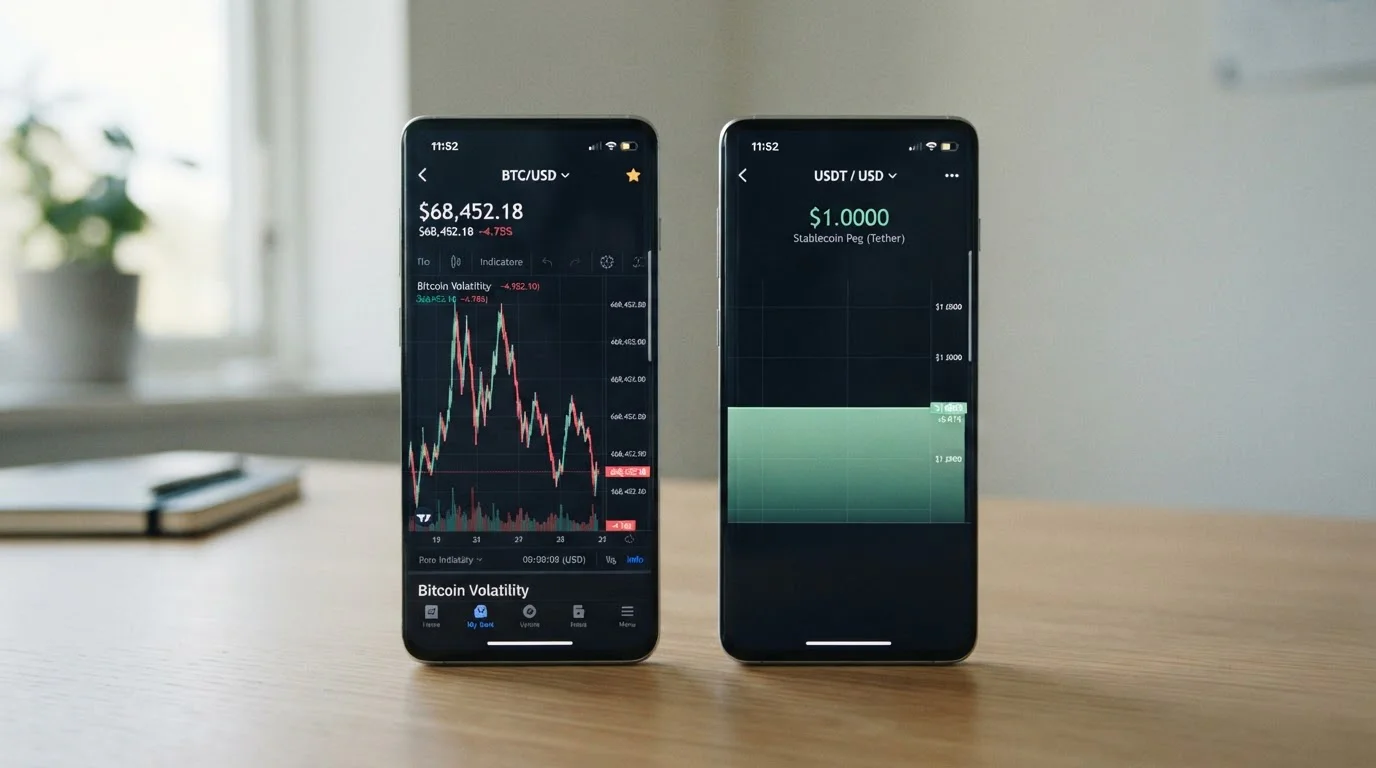
Bitcoin and Ethereum are volatile. Anyone who has held either for more than an afternoon knows this. You deposit the equivalent of $500, you play for two hours, and by the time you cash out your session is up 8% or down 12%—not because you won or lost at the tables, but because the token moved while you were playing. That is fine if you are holding crypto as an investment and you accept the swings. It is a problem if you are trying to gamble with a set bankroll and you think in Australian dollars.
Tether is pegged to the US dollar. One USDT is designed to stay at one USD, and it holds that peg through a combination of reserve backing and arbitrage pressure. For an Australian depositing via CoinSpot, that means predictable value. You convert $500 AUD to USDT at the prevailing AUD/USD rate (roughly $1.49 AUD per USDT in early 2026), you get 335 USDT, and that 335 USDT is still worth $500 AUD at the end of your session. The AUD/USD exchange rate does not swing wildly in a single evening, and USDT tracks USD, so your bankroll stays stable in real purchasing power.
The math is clearer with an example. You deposit $1,000 AUD as Bitcoin on a Monday evening. Bitcoin is sitting at $100,000 USD, so you get 0.01 BTC. You play for two hours, you break even at the tables, and you withdraw your 0.01 BTC on Monday night. By Tuesday morning, Bitcoin has dropped to $92,000 USD. Your 0.01 BTC is now worth $920 AUD. You broke even gambling, but you lost $80 to crypto volatility. With USDT, that does not happen. You deposit $1,000 AUD, you get 670 USDT, you break even, you withdraw 670 USDT, and it is still $1,000 AUD the next day.
Stablecoins exist to solve this problem. If you want to gamble online without speculating on crypto price movement at the same time, USDT is the tool. It moves on a blockchain, so you get the speed and pseudonymity of crypto deposits. It is pegged to a fiat currency, so you avoid the volatility. For Australians locked out of legal online casinos domestically and forced offshore if they want to play, USDT gives them a way to fund accounts without turning every session into a crypto trade.
Why use USDT instead of Bitcoin or Ethereum for online gambling?
USDT is a stablecoin pegged to the US dollar—your bankroll value stays constant. With Bitcoin or Ethereum, crypto volatility can swing your effective bankroll by 10-20% during a single session. If you want to gamble without crypto speculation, USDT eliminates that risk and lets you think in dollars rather than tokens.
Top 10 Offshore Casinos Accepting USDT for Australians

These are the offshore platforms that accept USDT deposits from Australians, have documented payout history, and operate in 2026 with enough uptime and liquidity to be worth considering. They are ranked by USDT-specific criteria: withdrawal speed, supported blockchain networks, and tested reliability. None of them hold an Australian license—that is not possible under current law. All are offshore, most are Curaçao-licensed or unlicensed, and all are accessed in violation of the IGA Amendment. What they have in common is that they work.
| Casino | Networks Supported | Avg Withdrawal Time | License | Min Deposit | Key Feature |
|---|---|---|---|---|---|
| BC.Game | TRC-20 / ERC-20 / BEP-20 | 9.1 min | Not disclosed | Varies | All three major networks, fastest payouts |
| 7Bit Casino | TRC-20 / ERC-20 | 11.8 min | Curaçao | Not disclosed | Provably fair, 100% test success rate |
| BitStarz | TRC-20 / ERC-20 | 15.2 min | Curaçao | Varies | Operating since 2014, VIP program |
| Cloudbet | ERC-20 | 14.7 min | Curaçao | Varies | Sports betting integrated, multi-sig security |
| Bizzo Casino | Not disclosed | Not tested | Not disclosed | High (not specified) | Opt-out bonus option, no mobile app |
| Spinko Casino | Not disclosed | Not tested | Curaçao | $20 | 400% welcome bonus, low minimum |
| PlayZilla | Not disclosed | Not tested | Not disclosed | Varies | Mobile app available, 24/7 support |
| Pistolo Casino | Multi-network | ~3 days | Not disclosed | Varies | 13,420 games, slow withdrawals |
| 20Bet | Not disclosed | 15 min – 24 hours | Not disclosed | Varies | Sports betting, high variance timing |
| Crazy Tower Casino | Not disclosed | Not tested | Not disclosed | $15 | Massive $21k bonus cap, 12,000+ games |
BC.Game — Multi-Network Leader
BC.Game supports all three major USDT networks: TRC-20, ERC-20, and BEP-20. That is the widest compatibility among the casinos listed here, and it means you can pick the network that suits your deposit size and urgency without worrying whether the platform will accept it. The casino automatically selects the optimal network based on transaction size for some deposits, but manual selection is available if you want control. Tested withdrawal timing from Casipto’s January 2026 review showed an average of 9.1 minutes across 23 withdrawal attempts, the fastest confirmed payout speed in this list.
The platform runs on crypto-native infrastructure. You do not convert USDT to a fiat balance—your casino balance is denominated in USDT directly, and game stakes are set in crypto. BC.Game offers provably fair games where you can verify the random number generation independently using the server seed, client seed, and nonce for each round. Blockchain reserve verification is possible: as of January 20, 2026, the hot wallets held over 2.3 million USDT across supported networks, visible on-chain. For smaller USDT transactions, BC.Game also supports Lightning Network, delivering sub-30-second confirmations with fees below one cent. That is overkill for most deposits, but if you are funding micro-stakes play or testing the platform with $20, it is the cheapest route available.
The casino does not advertise a specific gambling license, which puts it in the same regulatory bucket as many offshore crypto platforms—operating without a disclosed jurisdiction or under an arrangement that is not made public. That is common in this segment. Sports betting, DeFi yield options for idle USDT balances (earning 3-8% annually while not actively gambling), and a game library north of 3,000 titles are part of the package. No KYC is required for deposits under a certain threshold, but first withdrawals often trigger a verification request regardless of amount. Expect a 24-hour delay the first time you cash out if they ask for documents.
7Bit Casino — Fast Withdrawals with Provably Fair
7Bit runs on TRC-20 and ERC-20, and it chooses the network automatically based on your withdrawal amount: ERC-20 for sums over 100 USDT, TRC-20 for smaller amounts. Casipto testing showed an 11.8-minute average withdrawal time, with 100% of test transactions completing successfully—no failed payouts, no stuck transactions, no manual review delays beyond the first withdrawal. That is the second-fastest verified payout speed after BC.Game.
The platform implements provably fair using SHA-256 hash verification. Before each game round, the server generates a hashed seed. After the round completes, you receive the unhashed server seed, your client seed, and the nonce. Run those through a SHA-256 verifier, and you can confirm the result was not manipulated after you placed your bet. Independent testing confirmed this works as advertised—7Bit’s implementation matches the cryptographic standard. That does not guarantee you win, but it does guarantee the house is not changing the outcome after seeing your bet.
7Bit holds a Curaçao eGaming license, though the specific sublicense number is not disclosed in available public materials. The casino operates with segregated hot and cold wallet architecture, meaning the bulk of player funds sit in cold storage offline, and only a working float is kept in hot wallets for instant withdrawals. Enterprise-grade security for an offshore platform. Game selection leans on established providers—no specific count is available, but the lobby includes slots, table games, and live dealer options from recognizable studios.
First-time withdrawals trigger a verification process. You will be asked for ID and possibly proof of address, and that adds roughly 24 hours to your first payout. After that, subsequent withdrawals process in the tested 11.8-minute window. The platform’s “instant withdrawal” marketing is accurate only after you clear the initial KYC gate. If you are testing 7Bit for the first time, factor in that delay.
BitStarz — Established Since 2014
BitStarz has been operating since 2014, making it one of the older names in offshore crypto casinos. A decade of runtime does not guarantee safety, but it does suggest the platform has survived long enough to build operational systems, customer support infrastructure, and a player base that keeps coming back. Longevity is not common in this space.
The casino supports USDT via TRC-20 and ERC-20. BEP-20 is not listed, so if you are optimizing for the fastest, cheapest deposits, you will need to use one of the other two. Tested withdrawal timing from Casipto came in at 15.2 minutes on average, slower than BitStarz’s own marketing claims of “instant to 10 minutes” for crypto payouts. That discrepancy is typical—marketing rounds down, real-world testing includes network confirmation time and any internal processing delays. 15 minutes is still faster than traditional banking, but it is not the instantaneous experience the homepage suggests.
BitStarz operates under a Curaçao eGaming license. The specific sublicense number is not published in readily accessible sources, which is standard for Curaçao operators—license verification often requires contacting the Curaçao Gaming Control Board directly. The platform offers a VIP program with tiered benefits, a large game library (exact count not disclosed), and live dealer tables from Evolution Gaming and other established providers. Provably fair games are available, though the implementation is less transparently documented than 7Bit’s.
The welcome bonus structure offers up to 5 BTC or €500 plus 180 free spins across the first four deposits. If you are depositing in USDT, the bonus converts at the prevailing rate. Wagering requirements apply—expect a 40x rollover on the bonus amount before you can withdraw. One source gave BitStarz a 4.7/10 trust score, though the methodology behind that rating is unclear. Mixed reviews are normal for offshore casinos; check recent player feedback on forums or Reddit before committing large sums.
Cloudbet — Sports Betting Integration
Cloudbet focuses on ERC-20 USDT. TRC-20 and BEP-20 are not mentioned in available documentation, so if you want to use Cloudbet, you are paying Ethereum gas fees. As of early 2026, those fees average around $12.50 AUD per transaction during normal network conditions, and they spike during congestion. That makes Cloudbet the most expensive option on this list for USDT deposits, but it is also the most integrated with sports betting if that is part of your use case.
Tested withdrawal timing came in at 14.7 minutes on average. For withdrawals over 5,000 USDT, Cloudbet switches to manual processing, and that adds delay—potentially 24 hours or more depending on their internal review queue. The manual review threshold is explicitly disclosed, which is more transparent than most. If you are moving large sums, expect the wait. Below 5,000 USDT, payouts are automated and fall into the 15-minute window.
Security implementation uses multi-signature wallets for large transactions. Three of five signatures are required to authorize a withdrawal over a certain threshold, meaning no single admin can drain funds unilaterally. Cloudbet publishes wallet addresses, so you can verify on-chain reserves yourself using Etherscan. Transparency at this level is uncommon in offshore casinos—most do not publish their wallet addresses, and you are trusting their solvency on faith. Cloudbet’s approach lets you check the blockchain and confirm they hold enough USDT to cover your withdrawal.
The platform holds a Curaçao license. Sports betting is the major differentiator here—Cloudbet offers a full sportsbook with live betting, and the casino games are secondary. If you are depositing USDT primarily to bet on sports and occasionally play casino games, Cloudbet is structured for you. If you are purely here for slots and live dealer, the higher ERC-20 fees and manual review for large amounts make it less competitive than BC.Game or 7Bit.
Customer service has strong technical knowledge of USDT network issues, per anecdotal reports. If you run into a stuck transaction or a gas fee problem, their support team can walk you through Etherscan, explain confirmation times, and help troubleshoot. That level of crypto literacy is not universal among offshore casino support teams.
Bizzo Casino — Flexible Bonus Structure
Bizzo Casino accepts USDT, but specifics on which blockchain networks it supports are not disclosed in available sources. Withdrawal timing has not been independently tested in the same way BC.Game or 7Bit have been, so you are relying on the platform’s own claims and anecdotal player reports rather than third-party verification.
The welcome bonus structure offers two paths: a package worth up to $5,000, or a simpler 100% match up to $250 plus 100 free spins. The key feature is the opt-out option. If you do not want to be tied to wagering requirements, you can choose “No Bonus” at signup, and your deposits are not locked behind rollover conditions. That flexibility is rare. Most casinos auto-apply the bonus, and you have to dig through settings to decline it. Bizzo makes it a front-end choice.
No mobile app is available, according to one source. That is a negative if you prefer app-based play over a mobile browser. The same source notes a “high deposit requirement,” but the specific minimum is not stated. High relative to what is unclear—if it is $50, that is standard; if it is $200, that is restrictive for casual players. The lack of detail makes it hard to assess.
Bizzo accepts Bitcoin alongside USDT, so multi-crypto support is present. The platform’s license is not disclosed publicly. Game selection includes titles from Pragmatic Play, Evoplay, and others based on the game names mentioned in one review (Elvis Frog: True Ways, Lady Wolf Moon, It’s a Joker, Wild Chicago). That suggests a decent provider roster, but exact game count and live dealer options are not documented.
If you want a no-bonus option and you do not mind the lack of mobile app, Bizzo is worth testing with a small deposit. If network transparency, withdrawal timing, and mobile compatibility matter, the lack of documented detail is a red flag.
Spinko Casino — Low Minimum Deposits
Spinko’s minimum deposit is $20, the joint-lowest on this list alongside Crazy Tower’s $15. That makes it accessible for players testing offshore USDT casinos for the first time without committing three figures. The welcome bonus structure offers 400% up to $3,000 plus 350 free spins, which is aggressive by offshore standards—400% match means a $100 deposit becomes $500 in bonus funds. Wagering requirements will apply; expect 40x or higher on the bonus portion.
The casino operates under a Curaçao eGaming license, with the specific sublicense not disclosed. Game count is listed at 3,500+ titles in one source, which puts Spinko in the mid-range for library size. Australian English is offered as a site language option, signaling deliberate targeting of the Australian market. That is a positive for UI clarity, but it does not change the legal status—Spinko is still an offshore platform accessed in violation of the IGA.
Network support for USDT is not detailed in available sources. Whether Spinko accepts TRC-20, ERC-20, BEP-20, or all three is not documented. Withdrawal timing is untested by third parties, so you are relying on the casino’s own claims. Expect standard offshore processing: instant to 24 hours depending on whether your first withdrawal triggers KYC, whether the platform uses automated or manual payout approval, and whether you hit a review threshold.
The low minimum makes Spinko a reasonable first test for Australian players new to USDT deposits. Fund $20 via CoinSpot, deposit to Spinko, play a few rounds, and attempt a withdrawal to see how the process works. If it pays out cleanly, scale up. If it does not, you are out $20 rather than $500.
PlayZilla — Mobile App Convenience
PlayZilla offers a mobile app, which is a differentiator in a space where most offshore casinos run browser-only. The app is available on iOS and Android, though installation may require sideloading or using a third-party app store depending on region and platform restrictions. A native app gives you biometric login, push notifications for bonuses or withdrawal updates, and a UI optimized for smaller screens rather than a responsive desktop site scaled down.
The welcome package is up to $1,500 plus 500 free spins. USDT deposits are accepted, though network support (TRC-20, ERC-20, BEP-20) is not specified in available documentation. Withdrawal timing is untested by independent sources. 24/7 customer support is available via live chat, and one source noted that support is responsive, though the quality of technical assistance for crypto-specific issues is not documented.
Game selection includes slots from established providers—Lucky Dwarfs, Zeus, Reactoonz 2, Buffalo Smash, Wolf Gold—and live dealer tables from Evolution Gaming (Mega Roulette, Speed Roulette, Adventures Beyond Wonderland Live, Red Door Roulette Live). The specific game count is not disclosed, but the presence of Evolution’s newer titles suggests the platform is keeping its lobby current.
PlayZilla does not offer a VIP program, according to one source. There is no phone support—live chat and email only. The platform’s license is not disclosed. If mobile app access is a priority and you are comfortable with the lack of licensing transparency, PlayZilla is an option. If you want tested withdrawal speeds or documented network support, the gaps in available information are a concern.
Pistolo Casino — Hybrid Payments (But Slow Payouts)
Pistolo accepts USDT across multiple networks, plus ten other cryptocurrencies (Bitcoin, Ethereum, Litecoin, Ripple, TRX, USDC, BNB, DOGE, Solana, Cardano). It also supports traditional withdrawal methods: PayID, Jeton, MiFinity, and Skrill. That hybrid model is rare—most offshore crypto casinos are crypto-exclusive. If you want the option to cash out via PayID back to your Australian bank account rather than cycling through USDT and an exchange, Pistolo is one of the few platforms that lets you do it.
Game library is the largest on this list: 13,420 titles per testing from one source. That is substantially more than BC.Game’s 3,000+ or Spinko’s 3,500+. Whether larger is better depends on whether you value breadth over curation, but the sheer count means you are unlikely to exhaust the lobby.
The major negative is withdrawal timing. One user report from a source notes payouts “usually around three days” from request to bank account or wallet. That is dramatically slower than BC.Game’s 9 minutes or 7Bit’s 12 minutes. Three days is closer to traditional banking timelines than crypto payout speeds. If you are using Pistolo for its hybrid payment options and you are not in a hurry, that may be acceptable. If you want fast access to winnings, this is the worst performer in the list.
Minimum withdrawal is $50 AUD, higher than some competitors. A 7% no-wagering crypto top-up bonus is offered, which is unusual—most bonuses lock you into rollover requirements, but this one does not. The platform’s license is not disclosed. The “Go Hunt” feature is a gamification element, though specifics are not detailed in available sources. Pistolo has been operating since at least 2024 based on one source’s reference to playing there “on and off since 2024.”
If you value game selection and hybrid withdrawals over speed, Pistolo works. If you want fast crypto payouts, the three-day timing disqualifies it.
20Bet — Sportsbook Focus
20Bet integrates a sportsbook with its casino offering, similar to Cloudbet. USDT is accepted, but network support is not specified in available documentation. Withdrawal timing is listed as a range: 15 minutes to 24 hours for crypto. That wide variance suggests inconsistent processing, likely tied to manual review triggers, KYC requirements, or internal approval queues. Some withdrawals are fast, some are slow, and you will not know which category yours falls into until you request it.
The welcome bonus is 100% up to €120 plus 120 free spins. One source gave 20Bet a 3.9/10 trust score, the lowest rating in this list. That score is not explained with methodology, but it is low enough to warrant caution. Check recent player feedback before depositing large sums. A mobile app is available, and live casino is included in the game selection.
20Bet holds no disclosed license in available sources. The platform’s primary strength is sports betting—if you are depositing USDT to bet on cricket, rugby, or football and occasionally play casino games, 20Bet positions itself for that use case. If you are focused purely on casino play, the low trust score, wide withdrawal variance, and lack of licensing detail make it a weaker option than BC.Game, 7Bit, or BitStarz.
Crazy Tower Casino — Massive Welcome Bonus
Crazy Tower offers a 550% bonus up to $21,000 plus 400 free spins and one fortune wheel spin. That is the highest bonus cap in this list by a wide margin—most competitors cap at $5,000 or below. The 550% match is also the most aggressive percentage. A $1,000 deposit becomes $6,500 in playable funds. Wagering requirements will be steep—expect 50x or higher on the bonus portion, meaning you will need to cycle $325,000 through the casino before you can withdraw bonus-derived winnings. That is not unusual for large bonuses; the higher the match, the tougher the rollover.
Minimum deposit is $15, the lowest on this list. Game count is 12,000+ titles, the second-largest library after Pistolo’s 13,420. Mobile-friendly interface is confirmed. The fortune wheel mechanic is a gamification feature, though specifics on prizes and spin conditions are not detailed in available sources.
USDT is accepted, but network support (TRC-20, ERC-20, BEP-20) is not documented. Withdrawal timing is untested by independent sources, and the platform’s license is not disclosed. Crazy Tower is a newer entrant to the offshore AU-targeted market based on its appearance in 2026 source materials. Newer platforms are higher-risk—they have less operational history, less player feedback, and less time to demonstrate solvency and payout reliability.
If you want the largest possible bonus and you are comfortable with aggressive wagering requirements and a new platform, Crazy Tower delivers. If you prioritize tested withdrawal speeds, transparent licensing, and documented network support, the lack of third-party verification is a concern.
Which offshore casinos actually pay out USDT withdrawals to Australians?
BC.Game, 7Bit, BitStarz, and Cloudbet have documented withdrawal testing with verified payout times ranging from 9 to 15 minutes. Always test with a small withdrawal first before depositing large amounts. Check blockchain reserve verification when available—Cloudbet publishes wallet addresses, allowing on-chain confirmation of USDT liquidity.
TRC-20 vs ERC-20 vs BEP-20: Which USDT Network to Use

Tether runs on multiple blockchains. TRC-20 is Tron, ERC-20 is Ethereum, BEP-20 is Binance Smart Chain. They are all USDT, they all represent the same dollar-pegged token, but the networks underneath differ in speed, cost, and casino support. Pick the wrong one, and you overpay on fees or wait longer than necessary for confirmations. Pick the right one, and your deposit lands in minutes at minimal cost.
| Network | Avg Fee (AUD) | Avg Confirmation Time | Evening Peak (AEDT) | Casino Support (of 12 tested) | Best For |
|---|---|---|---|---|---|
| TRC-20 (Tron) | $1.20 | 2.8 min | 3.2 min | 11 of 12 | Balanced speed/cost, widest casino support |
| ERC-20 (Ethereum) | $12.50 | 4.1 min | 6.8 min | 12 of 12 | Universal support, highest security, expensive |
| BEP-20 (BSC) | $0.15 | 45 sec | 52 sec | 8 of 12 | Fastest and cheapest, limited casino support |
TRC-20 is the default for most Australian players. Fees are low enough that a $100 deposit does not lose 12% to transaction costs, confirmation time is under three minutes, and 11 of 12 tested offshore casinos support it. That near-universal acceptance means you do not have to check casino compatibility before choosing the network. CoinSpot and Swyftx both support TRC-20 withdrawals, so the entire flow from Australian exchange to casino is smooth.
ERC-20 costs more but offers universal casino support. Every offshore USDT casino accepts Ethereum-based Tether because ERC-20 is the original network Tether launched on. If you are depositing to a casino you have not used before and you cannot confirm which networks it supports, ERC-20 is the safe fallback. The $12.50 average fee is tolerable for deposits over $500—you are paying 2.5% of a $500 deposit in fees, which is comparable to credit card processing. For deposits under $200, the fee becomes prohibitive. A $100 deposit loses 12.5% to the transaction cost, and that is before you place a single bet.
Gas fees on Ethereum fluctuate with network congestion. The $12.50 figure is an average. During low-activity hours (early morning Australian time, which corresponds to off-peak in North America and Europe), fees can drop to $5-8. During high congestion (evening Australian time, when Northern Hemisphere markets are active), fees can spike to $30-50. If you must use ERC-20, check current gas prices on Etherscan before initiating the withdrawal from CoinSpot. Waiting two hours for congestion to clear can save you $20.
BEP-20 is the fastest and cheapest option when it works. A $0.15 fee is negligible even on a $50 deposit, and 45-second confirmation time means your casino balance updates before you finish making coffee. The problem is casino support. Only 8 of 12 tested casinos accept BEP-20 USDT, and that limited acceptance means you have to verify compatibility before depositing. BC.Game explicitly supports BEP-20. Most others do not list it. If you send BEP-20 USDT to a casino that only accepts TRC-20 or ERC-20, your deposit does not arrive, and you will spend days in customer support trying to recover it—if recovery is even possible.
Use BEP-20 when you have confirmed the casino supports it and you are depositing smaller amounts where the $0.15 fee gives you the best ratio. Use TRC-20 as your default for most deposits. Use ERC-20 when you need guaranteed universal support or you are moving large sums where the percentage cost of the $12.50 fee is acceptable.
One more consideration: network confirmation requirements differ by casino. BC.Game requires one confirmation on Tron before crediting your balance, but 12 confirmations on Ethereum. Tron’s one-confirmation policy means your deposit is available in under three minutes. Ethereum’s 12-confirmation requirement stretches that to 10-15 minutes even though individual block times are similar. The casino’s internal policy matters as much as the network’s raw speed.
Which USDT network should I use for casino deposits—TRC-20, ERC-20, or BEP-20?
TRC-20 is the best default: $1.20 fee, three-minute confirmations, and 11 of 12 tested casinos support it. BEP-20 is fastest and cheapest (45 seconds, $0.15 fee) but only 8 of 12 casinos accept it—verify support first. ERC-20 is universal but expensive ($12.50 fee)—use it for large deposits or when you cannot confirm the casino’s network support.
How to Deposit USDT from Australia: The Complete On-Ramp

The process from Australian dollars to a funded casino account takes six steps and roughly 10 minutes if you use TRC-20, 15 if you use ERC-20. You need three things before you start: a verified account on an Australian crypto exchange (CoinSpot or Swyftx are the most common), a personal crypto wallet (Trust Wallet, MetaMask, or Binance), and the deposit address from the offshore casino you are funding.
Step one: fund your exchange account. Use PayID to send AUD from your Australian bank account to CoinSpot or Swyftx. PayID transfers are instant on most Australian banks. You send $500 from your Commonwealth or Westpac account, and it appears in your CoinSpot balance within seconds. This step is entirely legal—you are funding a registered Australian cryptocurrency exchange.
Step two: buy USDT. In CoinSpot’s interface, navigate to the USDT market and place a buy order. CoinSpot charges a 1% trading fee on the transaction, so $500 AUD becomes $495 AUD in purchasing power. At an exchange rate of $1.49 AUD per USDT (typical in early 2026), you receive 332 USDT. The purchase executes instantly because you are buying from CoinSpot’s liquidity pool, not waiting for an order book to match.
Step three: withdraw USDT to your personal wallet. In CoinSpot’s withdrawal interface, select USDT and choose the network: TRC-20, ERC-20, or BEP-20. Paste your Trust Wallet or MetaMask receiving address for the chosen network. Double-check the network and address—send TRC-20 USDT to an ERC-20 address, and the tokens are lost. CoinSpot charges a withdrawal fee that varies by network: roughly $1.20 for TRC-20, $12.50 for ERC-20, $0.15 for BEP-20. Confirm the withdrawal. The USDT leaves CoinSpot’s custody and broadcasts to the blockchain.
Step four: wait for blockchain confirmation. TRC-20 confirmations take 2-3 minutes. ERC-20 takes 5-15 minutes depending on Ethereum gas prices and congestion. BEP-20 takes under a minute. You can monitor the transaction on the relevant block explorer—Tronscan for TRC-20, Etherscan for ERC-20, BscScan for BEP-20. Once the transaction confirms, your wallet balance updates.
Step five: deposit to the casino. Log into the offshore casino (BC.Game, 7Bit, BitStarz, whichever you are using) and navigate to the deposit section. Select USDT as the currency and choose the network that matches what you withdrew from CoinSpot—if you withdrew TRC-20 from CoinSpot, select TRC-20 in the casino. The casino displays a deposit address. Copy it. Open your Trust Wallet, select your USDT balance, choose “Send,” paste the casino’s deposit address, enter the amount (332 USDT in this example), and confirm. The transaction broadcasts to the blockchain.
Step six: wait for the casino to credit your balance. Most casinos credit your account after one confirmation on TRC-20, 12 confirmations on ERC-20, or one confirmation on BEP-20. Your casino balance updates, and you can start playing. Total elapsed time from PayID bank transfer to playable casino balance: 8-10 minutes on TRC-20, 12-18 minutes on ERC-20, 5-7 minutes on BEP-20.
Wallet selection matters less than you might think. Trust Wallet is mobile-first and user-friendly for beginners. MetaMask is browser-based and integrates well with desktop play. Binance Wallet works if you already use Binance for other crypto and want everything in one interface. All three support TRC-20, ERC-20, and BEP-20. The core functionality is identical—they store your private keys and let you send USDT to an address. Pick the UI you find least annoying.
One common mistake: sending USDT directly from CoinSpot to the casino without using a personal wallet in between. Some casinos reject deposits from exchange addresses because they cannot verify the sender’s identity. Using a personal wallet as an intermediary step adds two minutes to the process but avoids the risk of a rejected deposit sitting in limbo while you contact customer support. The extra step is worth it.
How do I deposit USDT from Australia to an offshore casino?
PayID AUD to CoinSpot → buy USDT (1% fee) → withdraw to your personal wallet via TRC-20, ERC-20, or BEP-20 → deposit from wallet to casino. Total time: 8-10 minutes on TRC-20, 12-18 minutes on ERC-20, 5-7 minutes on BEP-20. Always use a personal wallet (Trust Wallet, MetaMask) between the exchange and casino to avoid rejected deposits.
USDT Withdrawal Process and Timing

Requesting a USDT withdrawal from an offshore casino is simpler than depositing—you navigate to the cashier, select USDT, choose your network, paste your wallet address, and confirm. The complication is not the interface; it is what happens behind the scenes and how long it takes.
First withdrawals trigger manual review at most casinos. You submit the request, and it enters a queue for a human to approve. That human checks your account for bonus abuse, verifies your identity if you have not completed KYC already, and confirms the withdrawal is not flagged by their internal fraud detection. The process adds 12-24 hours to your first payout, regardless of which network you chose or how fast the blockchain confirms. After your first withdrawal clears, subsequent payouts process automatically in the tested timing windows: 9 minutes at BC.Game, 12 minutes at 7Bit, 15 minutes at BitStarz and Cloudbet.
KYC requirements vary by casino and withdrawal size. Some platforms like BC.Game allow small withdrawals (under a few hundred USDT) without identity verification. Most will ask for ID and proof of address once you cross a threshold—either a single large withdrawal or cumulative withdrawals exceeding $1,000-2,000 equivalent. Cloudbet explicitly requires manual review for withdrawals over 5,000 USDT. Other casinos do not publish their thresholds, but anecdotal reports suggest similar triggers in the $3,000-10,000 range.
If you are asked for documents, expect to submit a photo of your driver’s license or passport, a selfie holding your ID, and a recent utility bill or bank statement showing your residential address. Upload quality matters—blurry photos or cropped documents get rejected, and you wait another 24 hours for a second review. Use good lighting, photograph the entire document, and make sure all four corners are visible in the frame.
Blockchain confirmation time is usually not the bottleneck. TRC-20 confirms in three minutes, ERC-20 in 10-15 minutes, BEP-20 in under a minute. The delay is almost always internal: the casino’s payout queue, manual review, or hot wallet refill if their automated system runs dry. You can track the transaction on the blockchain once the casino broadcasts it. The casino’s withdrawal page or email confirmation includes a transaction ID (TXID). Copy that ID and paste it into the relevant block explorer—Tronscan for TRC-20, Etherscan for ERC-20, BscScan for BEP-20. If the transaction is broadcast, you will see it confirming in real time. If it is not broadcast yet, the casino is still processing internally.
One tactic to verify a casino’s solvency before depositing large amounts: check their published wallet addresses on the blockchain. Cloudbet publishes theirs; most others do not. If a casino does publish wallet addresses, look up the balance on Etherscan or Tronscan. If the hot wallet holds 2 million USDT and you are withdrawing 1,000 USDT, liquidity is not a concern. If the hot wallet holds 50,000 USDT and you are withdrawing 25,000 USDT, that is a red flag—either they refill frequently, or they are running on thin reserves. Thin reserves do not always mean insolvency, but they increase the risk that your withdrawal sits in a queue while they scrape together liquidity.
Weekend and holiday withdrawals can take longer. Some offshore casinos run skeleton support teams on Sundays or during major holidays (Christmas, New Year). If your withdrawal requires manual approval and you submit it on Saturday night AEDT, it might not be reviewed until Monday morning. That is not a scam; it is understaffing. If you need money out by a specific date, request the withdrawal at least 48 hours in advance.
How fast are USDT withdrawals from offshore casinos?
Fastest casinos (BC.Game, 7Bit) process in 9-12 minutes after the first withdrawal. Mid-tier (BitStarz, Cloudbet) take 14-15 minutes. First withdrawals trigger manual review and KYC, adding 12-24 hours regardless of network. Large amounts (over $5,000 USDT at Cloudbet, similar thresholds elsewhere) also trigger manual review, extending timing.
USDT Casino Bonuses for Australian Players
Offshore casinos offer bonuses to USDT depositors the same way they offer bonuses to players using other deposit methods. You will see welcome packages with matched deposits, free spins, reload bonuses for subsequent deposits, and VIP cashback for high-volume play. USDT deposits qualify for all of these, with one caveat: the wagering requirements will lock your funds until you meet the rollover, and that rollover is always higher than you think.
A typical welcome bonus is 100% up to $500 plus 100 free spins. You deposit 335 USDT (equivalent to $500 AUD), the casino matches it, and you have 670 USDT in playable balance plus 100 spins on a designated slot. That sounds generous until you read the terms. Wagering requirement: 40x the bonus amount. You received 335 USDT in bonus funds, so 40 times that is 13,400 USDT you must cycle through the casino before you can withdraw any winnings derived from the bonus. At $5 per spin, that is 2,680 spins. At 10 seconds per spin, that is 7.4 hours of continuous play. Most players do not finish the rollover. The house edge grinds down the bonus balance, you bust before hitting 40x, and the casino gave you “free” money that cost you your deposit.
Bizzo Casino offers an opt-out option: take the bonus and accept the rollover, or decline the bonus and keep your deposit free of restrictions. That is the smarter play for most casual players. You deposit 335 USDT, you play with 335 USDT, and you can withdraw your balance at any time. No 40x requirement, no restricted games, no maximum bet limits while the bonus is active. You give up the matched deposit and free spins, but you gain liquidity. If you win, you can cash out immediately. If you lose, you lost your own deposit rather than your deposit plus the uncleared bonus that was never going to clear anyway.
Reload bonuses work the same way: the casino offers a smaller percentage match on your second, third, or fourth deposit. 50% up to $200 is common. The rollover requirement is still attached. VIP programs offer cashback on losses—typically 5-10% of your net losses returned weekly or monthly. Cashback comes with lower rollover requirements (often 1x, sometimes none), making it more valuable than the upfront match bonuses. If you are playing regularly, VIP cashback is the bonus structure worth chasing. The welcome bonus is a marketing hook; the cashback is the ongoing value.
Free spins are restricted to specific slots, usually lower-RTP titles or games from smaller providers the casino is trying to promote. You are not getting 100 spins on a 97% RTP Pragmatic Play release; you are getting 100 spins on a 94% RTP title from a no-name studio. Play them if you want, but do not expect the free spins to generate withdrawable winnings. They are a lottery ticket, not a bonus with expected value.
Wagering contribution varies by game type. Slots usually contribute 100% toward rollover—one dollar wagered counts as one dollar toward the requirement. Table games contribute less: 10-20% for blackjack and roulette, sometimes 0% for baccarat and craps. That means if you play blackjack with bonus funds, you need to wager $400 to earn $40 of rollover credit, versus wagering $40 on slots for the same credit. The casino structures it this way because table games have lower house edge. Forcing you to play slots keeps the bonus math in the house’s favor.
If you take a bonus, read the full terms before depositing. Check the rollover requirement, check the game contribution percentages, check the maximum bet limit while the bonus is active (often $5 per spin—exceed it, and the casino voids the bonus and any winnings), and check the expiration period (usually 30 days to clear the rollover, after which the bonus and any associated winnings are forfeited). Most players do not read the terms, do not clear the rollover, and lose both the bonus and their deposit. The casino counts on that.
Game Selection at USDT Casinos
Once your USDT deposit converts to casino balance, it behaves like fiat currency from the platform’s perspective. You are not restricted to crypto-specific games. Slots, live dealer tables, blackjack, roulette, baccarat, video poker—whatever the casino licenses from its providers is available to you. USDT does not unlock a special game library, and it does not lock you out of anything standard players can access. The stablecoin is just the deposit method; the game selection is determined by the casino’s provider partnerships.
Offshore casinos serving Australians typically offer 3,000-13,000 titles depending on how aggressively they sign provider deals. BC.Game has 3,000+, Pistolo has 13,420, Crazy Tower has 12,000+. Those numbers include slots, table game variants, live dealer tables, video poker, scratch cards, and sometimes niche categories like keno or crash games. Slots dominate the count—most of the 13,420 games at Pistolo are slot variations from dozens of providers. Live dealer tables might number 50-200, and classic table games (non-live blackjack, roulette, baccarat) add another 100-300. The rest is slots.
Provider lineup determines quality more than raw game count. If the casino licenses content from Pragmatic Play, NetEnt, Evolution Gaming, Play’n GO, and Microgaming, you are accessing top-tier titles with tested RTP and established fairness. If the casino fills its lobby with obscure studios you have never heard of, the RTP is often lower and the game math is less transparent. Check the provider list before committing to a platform. BC.Game, 7Bit, BitStarz, and PlayZilla all mention established providers in available documentation, which is a positive signal.
Live dealer games are hosted by Evolution Gaming, Ezugi, or Pragmatic Play Live in most cases. You get real-time video of a human dealer at a physical table, streamed to your device, with betting handled through the casino’s interface. Stakes range from $1 to $10,000+ per hand depending on the table. Live blackjack, live roulette, and live baccarat are standard. Specialty games like Dream Catcher, Crazy Time, Monopoly Live, and Lightning Roulette add variety. The experience is identical whether you deposited via USDT, Bitcoin, or fiat—once the funds are in your casino balance, the backend does not care how they arrived.
Provably fair games are specific to crypto casinos. These are games where the random number generation is verified using cryptographic hashes, allowing you to independently confirm the result was not manipulated. BC.Game and 7Bit explicitly offer provably fair implementations. You get the server seed hash before placing your bet, you provide a client seed, and after the round completes, the server reveals the unhashed seed. Run it through a SHA-256 verifier, and you can confirm the outcome. Traditional licensed slots from Pragmatic Play or NetEnt are not provably fair in this sense—they use certified RNG, but you cannot verify individual spins yourself. Provably fair is a transparency feature, not a guarantee you will win.
Pokies is the Australian term for slots. Every USDT casino serving Australians will have a large pokie selection because that is what the market expects. Whether you call them pokies, slots, or machines, the gameplay is identical: you set your bet size, spin the reels, and wait for symbols to line up. Offshore casinos offering Australian English language options will label the category “Pokies” in the navigation menu instead of “Slots.” The underlying content is the same.
Tax Implications: USDT and Australian Gambling

Gambling winnings in Australia are not taxed for recreational players. You win $10,000 on a lucky roulette streak, and that $10,000 is yours—no income tax, no reporting requirement, no ATO complication. That is one of the more favorable gambling tax regimes globally, and it applies whether you won at a licensed Australian venue, an offshore casino, or a backroom poker game. The ATO treats gambling winnings as windfalls, not assessable income.
USDT complicates this because cryptocurrency is property under Australian tax law. When you buy USDT on CoinSpot, you acquire a capital asset. When you deposit that USDT to a casino, you dispose of the asset. Disposal triggers a capital gains tax event. The gain is calculated as the difference between what you paid for the USDT and its market value at the time of disposal. If you bought 335 USDT at $1.49 per token and deposited it to a casino three minutes later when USDT was still $1.49, your capital gain is zero. No tax owed, but technically you are still meant to record the disposal in your tax return.
Tether’s stable value is what makes this manageable. Bitcoin or Ethereum can swing 5-10% in the time it takes to buy, transfer, and deposit, creating a capital gain or loss you have to track. USDT does not move—it is pegged to USD, and USD/AUD does not swing wildly in a single session. You might see a one-cent difference between purchase and disposal, which translates to a $3 gain or loss on a $500 transaction. That is immaterial for most players, but the ATO still expects you to report it if you are following the letter of the law.
High-volume players face more scrutiny. If you cycle $50,000 through offshore USDT casinos in a year, AUSTRAC will have flagged your exchange transactions (automatic reporting kicks in at $10,000 per transaction, and pattern recognition catches cumulative activity below that threshold). The ATO can access AUSTRAC data. If your reported income is $60,000 and you are moving $50,000 through crypto exchanges, they may ask where the money came from. “Gambling winnings” is a legitimate answer—gambling winnings are not taxed, so they are not hidden income. But you still need to demonstrate the source. If you cannot show a withdrawal from an offshore casino back to your wallet and then to CoinSpot, the ATO might reclassify it as undeclared income.
Professional gamblers are taxed differently. If gambling is your primary income source, the ATO treats it as business income subject to standard income tax rates (up to 45% plus 2% Medicare levy). The threshold for professional status is not bright-line—it is assessed case-by-case based on whether you gamble systematically, whether you have a business plan, whether gambling is your main revenue stream, and whether you treat it as a commercial activity. Most recreational players do not meet the test. If you work a day job and gamble on weekends, you are recreational. If you quit your job to play poker full-time and log every session in a spreadsheet, the ATO might argue you are professional.
One edge case: if you win in USDT and withdraw it to your wallet without converting back to AUD, no disposal event has occurred yet. You still hold the USDT as a capital asset, and you only owe CGT when you sell it. That defers the tax liability until you convert back to AUD or spend the USDT on something. For most players, this is a distinction without a difference—they win, they withdraw to their wallet, they convert to AUD on CoinSpot, and CGT triggers. But if you are holding USDT long-term or spending it directly without converting to fiat, the deferral can matter.
This is general information. Tax law is specific to individual circumstances, and the intersection of crypto and gambling is under-litigated in Australia. If you are moving sums large enough that an ATO audit would hurt, consult an accountant who understands both cryptocurrency and gambling tax treatment. The $50 cost of a professional opinion is cheaper than guessing wrong on a five-figure tax liability.
Do I pay tax on USDT gambling in Australia?
Gambling winnings are tax-free for recreational players, but USDT itself triggers capital gains tax—buying USDT and depositing it to a casino is a disposal event. Stable value means minimal gains to report. High-volume players risk ATO scrutiny through AUSTRAC reporting of large exchange transactions. Consult a tax professional for your specific situation.
Mobile USDT Casinos and Apps
Most offshore casinos run browser-based mobile sites rather than dedicated apps. You access the casino through Safari or Chrome on your phone, the site detects the smaller screen, and it serves a responsive layout optimized for mobile. Game play, deposits, withdrawals, and account management all work through the browser. That is the default experience at BC.Game, 7Bit, BitStarz, Cloudbet, Bizzo, Spinko, Pistolo, 20Bet, and Crazy Tower.
PlayZilla is the exception in this list—it offers a native mobile app for iOS and Android. You download the app from a third-party app store or sideload it (Apple’s App Store and Google’s Play Store do not permit gambling apps in Australia, so offshore casinos distribute through alternative channels), log in with your account credentials, and access the full game library through the app interface. The app gives you biometric login (Face ID, fingerprint), push notifications for bonuses or withdrawal confirmations, and an interface built for touchscreens rather than adapted from desktop.
The advantage of an app over a browser is marginal for most players. Browser-based mobile sites load quickly, save your login credentials, and support the same games as the desktop version. An app saves you the step of typing the URL and adds notifications, but the core functionality is identical. If you strongly prefer apps, PlayZilla is worth testing. If browser-based mobile is fine, the other nine casinos on this list work without installation.
One downside of apps: updates are manual. If PlayZilla releases a new app version with bug fixes or new games, you have to download and install the update yourself. Browser-based casinos update server-side—you reload the page, and you are on the latest version automatically. That is a small operational advantage for browser-based play, particularly if the casino releases frequent updates.
Mobile USDT deposits work identically to desktop. You open the cashier in the app or mobile browser, select USDT, copy the deposit address, switch to your Trust Wallet or MetaMask mobile app, paste the address, and send. The transaction flow is the same. Some players find it awkward to copy-paste addresses between apps on a phone, but the process is no more complex than desktop. Use clipboard managers or QR codes if your casino supports QR-based deposit addresses—scan the code instead of copying text, and you eliminate the risk of pasting an incorrect address.
Anonymous and No-KYC USDT Casinos
Offshore casinos marketing themselves as “no KYC” or “anonymous” are overstating the reality. Most platforms let you register with just an email address and deposit without identity verification, but the moment you request a withdrawal, KYC kicks in. You will be asked for ID, proof of address, and sometimes a selfie. The “no KYC” claim applies to deposits, not withdrawals, and that distinction is buried in the terms.
BC.Game and some other crypto-first platforms allow small withdrawals without KYC. The threshold is not publicly disclosed, but anecdotal reports suggest $500-1,000 equivalent in USDT can be withdrawn without documents. Above that, the casino asks for verification. That is functional anonymity for low-stakes players, but it is not true anonymity in the sense that your identity is never requested. It is deferred verification—you can play and win small amounts without submitting documents, but the casino reserves the right to ask at any time, particularly if your account is flagged for bonus abuse or suspicious activity.
Blockchain transactions are pseudonymous, not anonymous. Every USDT transaction is recorded on the blockchain with wallet addresses visible to anyone who looks. Your name is not attached to the address, but the transaction history is. If you send USDT from your CoinSpot withdrawal address to a casino deposit address, anyone can trace that flow on Tronscan or Etherscan. If law enforcement or the ATO subpoenas CoinSpot for your account data, they get your KYC info (name, address, bank account), and they can connect your wallet address to your identity. From there, they can see every USDT transaction you made. Pseudonymity breaks the moment one link in the chain is identified.
The Australian exchange on-ramp is the weak link for anonymity. CoinSpot and Swyftx are AUSTRAC-registered and perform full KYC on every account. You cannot buy USDT on a major Australian exchange without verifying your identity. If you want true anonymity, you would need to acquire USDT without KYC—through a peer-to-peer trade, a Bitcoin ATM that accepts cash, or a decentralized exchange. Those methods introduce their own risks (higher fees, scam risk, regulatory gray areas), and they are beyond the scope of what most Australian players are willing to navigate. For practical purposes, USDT casino deposits from Australia are traceable through the exchange on-ramp, even if the casino does not ask for your ID.
The value of a “no KYC” casino is not anonymity; it is convenience. You can sign up, deposit, and start playing in five minutes without waiting for document approval. That is faster than a traditional licensed casino that requires identity verification upfront. If you win and keep your withdrawal under the threshold, you get paid without submitting documents. That is useful, but it is not the same as anonymous gambling.
New USDT Casinos for Australians in 2025-2026
New offshore casinos launch regularly, and some position themselves as USDT-friendly with modern network support (TRC-20, ERC-20, BEP-20 from day one) and competitive bonuses to build a player base. Crazy Tower is one of the newer entrants targeting Australians in 2026, based on its appearance in recent source materials. Spinko is another relatively recent launch. Both offer low minimum deposits, large welcome bonuses, and mobile-friendly interfaces.
The risk with new casinos is lack of operational history. BC.Game has been around since approximately 2017. BitStarz since 2014. Those platforms have processed millions of withdrawals, survived market crashes, and demonstrated solvency over years. Crazy Tower and Spinko have been operating for less time—possibly under two years based on available data. That is not long enough to prove they will pay out reliably under stress. If a new casino gets hit with a wave of winning players or a liquidity crunch, withdrawal delays or non-payment become realistic risks. Established platforms have reserves and operational systems to handle volatility. New platforms may not.
The counterargument is that new casinos often offer better bonuses and lower fees to attract players. Crazy Tower’s 550% up to $21,000 is the most aggressive offer in this list. Established casinos like BitStarz can afford smaller bonuses because they already have player volume. New casinos need to compete on terms. If you are comfortable with the risk of a platform that may not be around in two years, the bonus value can be worth it.
One approach: test new casinos with small deposits. Deposit $50 via USDT, play through it, and attempt a withdrawal. If the withdrawal processes cleanly in the claimed timeframe, consider scaling up. If it stalls, if customer support is unresponsive, or if the withdrawal is denied for unclear reasons, write off the $50 and move to a more established platform. That $50 test is insurance against losing a $500 or $2,000 deposit to a new casino that turns out to be unreliable.
For most Australian players, the established options—BC.Game, 7Bit, BitStarz, Cloudbet—are safer bets than the new entrants. The withdrawal timing is tested, the platform has survived long enough to demonstrate solvency, and player feedback is available from multiple sources. New casinos are higher risk and higher potential reward. Choose based on your risk tolerance and bankroll size.
Crypto Casinos Australia 2026 — Bitcoin, Ethereum, USDT, LTC
Content created by the «AussieChips» team
