
$5 Minimum Deposit Pokies in Australia: What Five Bucks Really Gets You in 2026
 Available in US
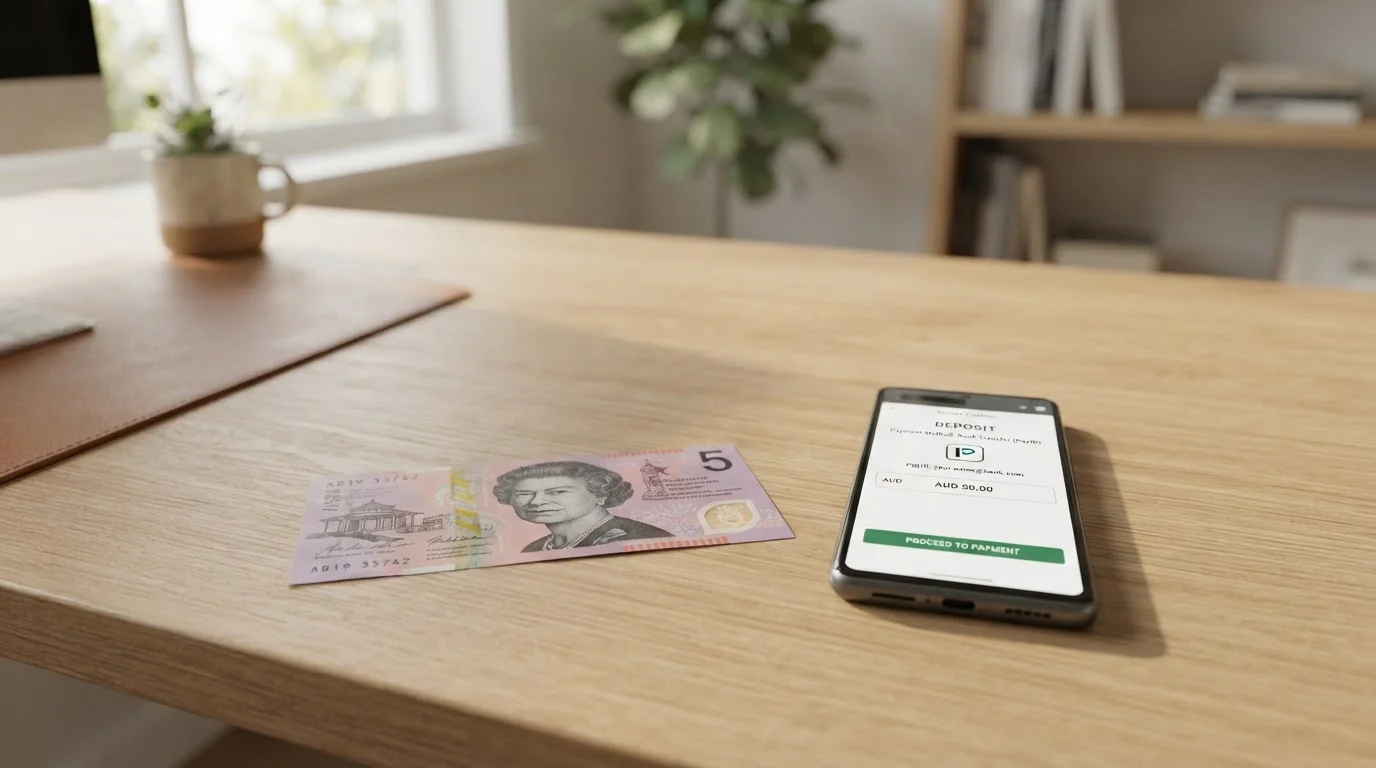
Five dollars is the smallest deposit that still functions as a real transaction at an offshore pokies site. Below that, the cashier either refuses the amount outright or the payment rail eats so much of it that nothing usable lands. Above it, you are into the $10 and $20 brackets where the bonus offers actually switch on.
So the five-dollar mark sits in an odd spot. It works. It just does not work the way the banner ads imply.
What a $5 Deposit Actually Buys You in 2026
A $5 deposit buys between 10 and 50 spins depending on the pokie you pick, and nothing else. No welcome bonus at most sites, no free spins package, no VIP tier. What it does buy is information: whether the cashier accepts your payment method, how long verification takes, and whether the withdrawal pipeline is real or decorative.
The maths is not complicated, which is why it is strange that almost nobody spells it out. A pokie with a $0.10 minimum spin gives you 50 pulls from $5. Push the stake to $0.20 and you have 25. At $0.50 — ten spins, then you are done. Most modern titles from Pragmatic Play or Play’n GO sit at $0.10 to $0.20 as their floor, so the realistic range is 25 to 50 spins before variance decides your evening.
Here is the part that matters more than spin count. Every offshore casino sets a minimum withdrawal, and every one of them sets it well above $5. The common floor is $20 to $30 via bank rails, $25 to $50 on cards, and sometimes higher on crypto depending on network conditions. Translate that into growth requirements: to cash out at a $20 threshold, your $5 must become $20 — a fourfold increase. At $30, six times. At $50, ten times.
On a 96% RTP pokie, the house takes four cents of every dollar wagered over the long run. Turning $5 into $50 is not impossible; it happens to somebody every day. It is just not the expected outcome, and pretending otherwise is how people end up depositing another twenty to “chase” the first five.
What the five-dollar deposit is genuinely good for: a dry run. You find out whether PayID lands instantly at that site, whether the account verification demands a utility bill before you have even placed a bet, whether support answers in twenty minutes or twenty hours. That intelligence is worth five dollars. The pokies session is a bonus, and I use that word carefully.
Can I really deposit just $5 at Australian online casinos?
Yes, at a minority of offshore sites, and almost always through a narrow set of payment methods. PayID is the most reliable rail at that figure. Cards and vouchers usually impose a $10 floor. Expect no welcome bonus and a minimum withdrawal several times the size of your deposit.
The Offshore Sites That Genuinely Accept $5 from Australians
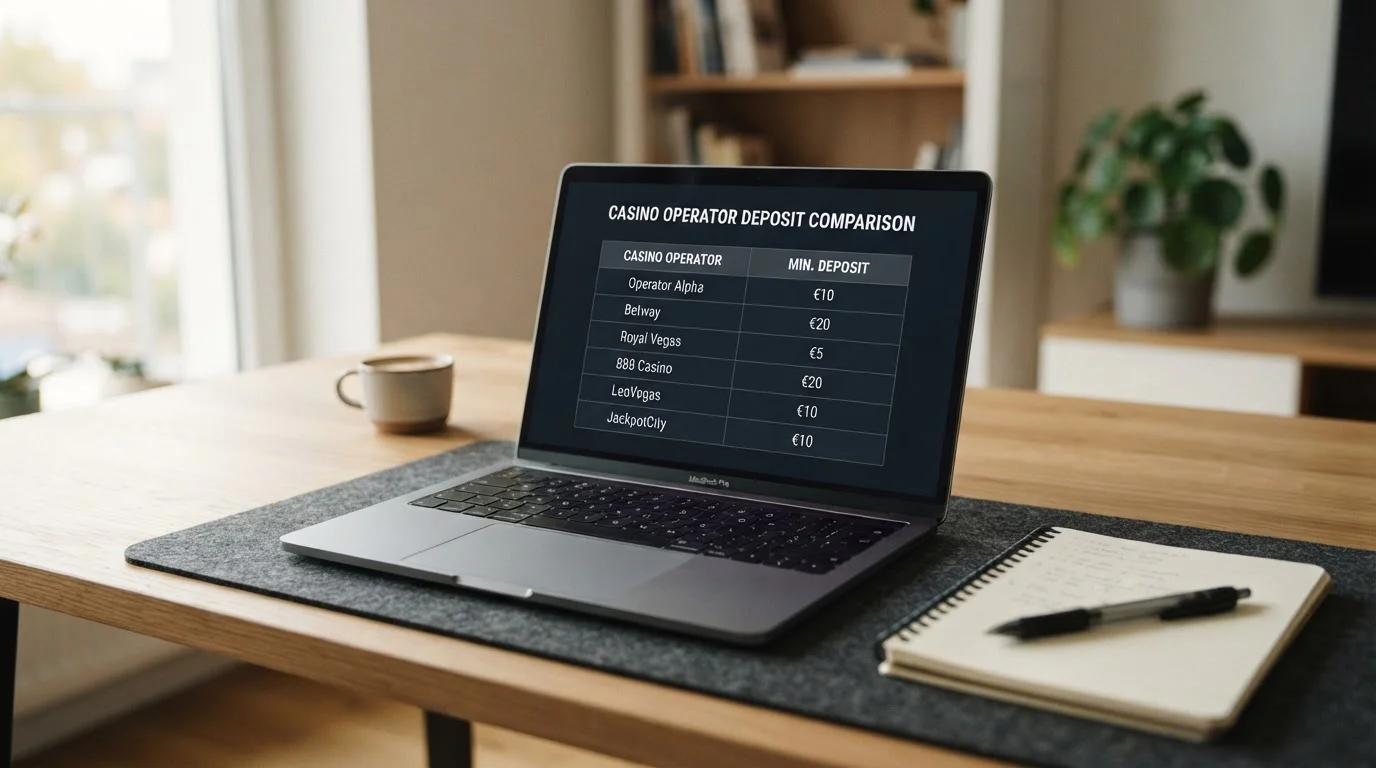
Twelve brands turned up repeatedly across Australian-facing comparison pages with a five-dollar cashier floor attached to them. The list below is ordered by how well each one actually serves a small-stakes deposit, not by whatever rating an affiliate ranking assigned it. And a caveat before the table: the $5 figure is almost always method-dependent. A site that advertises “deposits from $5” often means PayID from $5 and $20 on everything else.
| Operator | Licence | Min deposit | Min withdrawal | PayID | What sets it apart |
|---|---|---|---|---|---|
| SkyCrown | Curaçao 8048/JAZ | A$20 (PayID) | A$30 | Yes, both ways | Fastest verified PayID payout — 11 minutes in one real-money test |
| Royal Reels | Curaçao (undisclosed number) | A$10 (PayID), A$30 (cards, crypto) | A$30 | Yes | Lowest confirmed PayID floor in the AU offshore market |
| Spinjo | Curaçao GCB OGL/2023/176/0095 | A$5 | A$30 | Yes | Only brand here with a consistently disclosed licence number |
| SpinsUp | Curaçao 8048/JAZ (disputed) | A$5 | A$30 | Yes | 150+ game studios, daily cashback |
| 21bit | Curaçao 8048/JAZ2020-013 | A$5 | A$30 | Fiat and crypto | 11,000+ titles, largest library on this list |
| 7Bit | Curaçao (number not displayed) | A$5 | A$30 | Yes | Operating since 2014, longest track record |
| Katsubet | Curaçao 8048/JAZ2020-013 | A$5 | A$30 | Yes | Welcome offer denominated in Bitcoin |
| Spin Samurai | Curaçao (undisclosed) | A$5 | A$30 | Yes | A$5,000 + 150 free spins headline package |
| Goldenbet | Curaçao (undisclosed) | A$20 | A$30 | Yes | Trading since 2022, no-wagering cash gift |
| Millioner | Not disclosed | A$5 | A$30 | Yes | 200% match to A$3,750 + 200 spins |
| Rocket Play | Curaçao framework | A$10–A$35 by method | A$30 | Yes | 80+ studios, crypto payouts in minutes |
| Nitrobet | Not disclosed | A$5 | Not published | Listed | Thin public record — verify before funding |
The minimum deposit is what the cashier accepts. The minimum withdrawal is what you need in your balance before you can request a payout. That gap is where most five-dollar sessions end quietly.
SkyCrown — Fastest PayID Withdrawals Verified
SkyCrown has been around the Australian offshore scene long enough that its name stopped needing an introduction. It runs on Curaçao licence 8048/JAZ issued by Antillephone, the same master permit backing a dozen other brands. The game library hovers between 5,000 and 6,000 titles depending on who is counting, and the welcome structure is a four-stage package somewhere between $4,000 and $8,000 plus hundreds of free spins. Numbers vary because the promotion changes every few weeks and affiliate sites do not always keep pace.
What actually distinguishes SkyCrown in the context of a five-dollar deposit is the withdrawal pipeline. One competitive test clocked a PayID payout at 11 minutes from request to funds received. That is the fastest verified time among Australian-facing brands at this tier. The stated range is two to four hours for PayID, which is already faster than most, but 11 minutes suggests the cashier is automated end-to-end rather than queued for manual approval. Minimum withdrawal sits at $30, so a $5 deposit needs to grow six times before you can take anything out. Crypto and PayID are both supported, and the $20 deposit floor on PayID is the practical threshold most players hit anyway.
Spinjo — SoftSwiss Platform with Transparent Licensing
Spinjo is built on the SoftSwiss white-label platform and operated by Hollycorn N.V. under Curaçao Gaming Control Board licence OGL/2023/176/0095. That licence number is consistently displayed across multiple sources, which puts Spinjo ahead of several competitors on basic disclosure. SoftSwiss is a known quantity — over a hundred offshore casinos run on it, so the cashier, the KYC flow, and the game aggregator all follow tested patterns.
The game count ranges from 5,000 to 7,000 depending on which providers are active at any given time, and the welcome offer is structured across multiple deposits with anywhere from $2,000 to $5,000 in matched funds plus 100 to 300 free spins. The platform is HTML5, no app required, and works cleanly on mobile browsers. For a five-dollar test deposit, Spinjo offers a straightforward experience with no particularly surprising quirks. It accepts PayID, cards, e-wallets, bank transfers and crypto in AUD. Minimum withdrawal is $30 across most methods.
Millioner — 200% Bonus and Fast Withdrawals
Millioner is a thin public profile with one strong data point: it ranked third in a fast-withdrawal comparison, behind only SpinsUp and Spinjo. The welcome offer is a 200% match up to $3,750 plus 200 free spins, which is a steeper multiplier than the standard 100% but comes with whatever wagering requirement the terms bury in the fine print.
Operator, licence jurisdiction and ownership are not disclosed in any easily accessible public source, which is common in the offshore space but not ideal. The brand appears in multiple Australian-facing $5 deposit lists, so the cashier floor is likely real, but beyond the bonus structure and the withdrawal-speed ranking there is not much substantive detail available. Verify the licence and check a test withdrawal before moving serious money through the account.
Goldenbet — Longest-Running $5 Deposit Brand
Goldenbet has been trading under the same name since 2022, which in the churn-and-burn offshore market counts as longevity. Most brands that surface in Australian search results last a season, grab affiliate commissions, then vanish when complaints pile up or payment processors pull out. Goldenbet made it past the two-year mark, and that modest track record matters more than any headline bonus figure.
The welcome structure varies depending on where you read about it. One version offers a $100 AUD cash gift across the first three deposits with no wagering requirement attached. Another describes a €1,500 total across three deposits with 35× wagering. The divergence suggests either time-limited promotions or inconsistent regional offers. No-wagering cash gifts are rare in offshore bonuses because they cut directly into house margin, so if that version is real it is worth noting — and reading the terms twice.
Licence jurisdiction is not explicitly published in the available sources but is almost certainly Curaçao based on the pattern. Minimum deposit sits at $20 AUD for most methods, which pushes Goldenbet slightly above the pure five-dollar floor but still within the low-entry bracket. AUD is supported natively.
Nitrobet — Minimal Public Profile
Nitrobet appears in one affiliate ranking at 9.6 out of 10 and nowhere else in detail. No disclosed operator, no published licence number, no distinguishing feature mentioned beyond the $5 minimum deposit claim. The minimum withdrawal is not published, which is a red flag when every other metric on this list can be verified from at least two sources.
This one is included for completeness because it shows up in compiled $5 deposit lists, but the lack of transparency means you are flying blind. Either the brand is too new to have built a public record or it operates with minimal disclosure by design. Check the cashier for a displayed licence before depositing, and do not move money you cannot afford to lose on a test run.
Rocket Play — $10,000 Bonus and 80+ Providers
Rocket Play (also styled RocketPlay) operates under an offshore Curaçao framework and targets Australian players with a welcome package advertised at up to $10,000 AUD. That figure is among the highest on this list, but the structure is almost certainly multi-stage with steep wagering requirements attached. The game library draws from 80-plus studios, which is above average for this tier.
Minimum deposit is inconsistent across sources: one lists $10 AUD, another $35 AUD. The divergence is likely method-dependent — PayID or crypto at the low end, cards and bank transfers higher. Crypto withdrawals are advertised as settling in minutes rather than hours or days, which if accurate makes Rocket Play one of the faster cashouts for Bitcoin or Ethereum users. Minimum withdrawal is $30 AUD on most rails. AUD accounts, PayID, Neosurf, e-wallets and crypto are all supported.
Royal Reels — $10 PayID Minimum (Lowest Verified)
Royal Reels claims the lowest confirmed PayID minimum deposit in the Australian offshore market at $10 AUD, though one source lists $30 for cards and crypto. The welcome offer is a straightforward 100% match plus 50 free spins on the first deposit, smaller than most competitors but cleaner in its structure. The Australian branding is overt — name, visuals, promotional language — which is a calculated play for local trust in a market with zero domestic licensing.
Licence jurisdiction is Curaçao, but the specific number is not disclosed in the available sources. Minimum withdrawal is $30 AUD, so even a $10 deposit needs to triple before a cashout becomes possible. PayID is supported for both deposits and withdrawals, and the emphasis in the marketing is heavily on that rail. Visa, Mastercard and crypto are also accepted but sit at higher minimums.
Spin Samurai — $5,000 Welcome and Mid-Tier Presence
Spin Samurai offers a welcome package of $5,000 AUD plus 150 free spins, distributed across multiple deposits. The $5 minimum deposit is verified by inclusion in several Australian-facing $5 lists, and AUD accounts with PayID support are standard. Licence jurisdiction is Curaçao but the specific number is not disclosed.
Beyond the headline bonus and the low deposit floor, Spin Samurai does not have a clear distinguishing feature. It sits in the mid-tier of this group: functional cashier, standard Curaçao setup, game library in the 3,000 to 5,000 range, no particularly fast or slow withdrawals reported. Minimum withdrawal is $30 AUD on most methods. It works, but nothing about it pushes ahead of SkyCrown or Spinjo for a test deposit.
7Bit Casino — Crypto-First Since 2014
7Bit launched in 2014, making it the oldest continuously operating brand on this list by a wide margin. Twelve years is a lifetime in the offshore casino space, where most operators fold or rebrand within three. The site is operated by Dama N.V., a white-label platform provider behind several other brands in this segment, and holds a Curaçao Gaming Authority licence, though the specific number is inconsistently disclosed. One audit in July 2026 noted that no licence number, operator name or regulator appeared anywhere on the live site, which is a transparency issue.
7Bit is crypto-first by design. Bitcoin, Ethereum, Tether and other coins are the primary deposit and withdrawal methods, with AUD and cards supported as secondary options. The game library runs between 7,000 and 10,000 titles depending on the source, which is among the largest counts here. The welcome package totals somewhere between $10,000 and $10,800 across multiple deposits, with the first-deposit match at 100% up to $400 or $800 depending on the promotion. Weekly cashback and reload bonuses are part of the retention structure.
Crypto withdrawals are fast — minutes to a few hours for Bitcoin and Ethereum. Minimum deposit is $5 implied by inclusion in $5 deposit lists, though crypto minimums can be misleading when network fees eat a chunk of small amounts. Minimum withdrawal is $30 AUD on fiat rails. The longevity is the real selling point here. Most offshore brands do not make it to year three. 7Bit made it past twelve.
Katsubet — BTC-Denominated Bonus
Katsubet runs under Curaçao licence 8048/JAZ2020-013 issued by Antillephone N.V., the same permit as 21bit. Both are part of the Dama N.V. operator group and share infrastructure. The welcome bonus is denominated in Bitcoin — 100% up to 1.5 BTC plus 100 free spins — which signals a crypto-first positioning even though AUD and fiat rails are supported.
Game library is in the 5,000-title range, sourced from the standard Dama N.V. provider roster. Minimum deposit is $5 AUD implied, and minimum withdrawal is $30 on most methods. Crypto deposits and withdrawals are emphasized in the marketing, and settlement times are quoted in hours rather than days. For a five-dollar test, Katsubet functions the same as any other Dama N.V. brand on this list — clean cashier, standard KYC, predictable flow. The BTC bonus is the only real distinguisher.
21bit Casino — Largest Game Library (11,000+ Titles)
21bit launched in 2022 under Curaçao licence 8048/JAZ2020-013 and is operated by Dama N.V. The headline feature is the game library: 11,000-plus titles, the largest confirmed count on this list. That total comes from aggregating 60-plus providers through the Dama N.V. white-label platform, so the variety is real even if much of it sits in the long tail of low-traffic slots.
Welcome bonus is 100% up to $1,000 or $2,000 AUD (sources vary) plus 250 free spins across multiple deposits. High-volatility pokies and instant crypto payouts are pushed in the marketing. AUD and crypto are both supported, and minimum deposit is $5 implied by inclusion in multiple $5 lists. Minimum withdrawal is $30 on most methods. The focus on high-volatility titles makes 21bit a strange fit for a five-dollar session — variance chews through small stakes quickly on high-vol pokies — but the library size means low-volatility options are there if you filter for them.
SpinsUp — 6,000+ Pokies and Daily Cashback
SpinsUp launched in 2024 and has already accumulated conflicting licensing disclosures. One source cites Curaçao eGaming licence 8048/JAZ through Antillephone N.V. Another lists Anjouan gaming authority. A third claims Tobique Gaming Commission. Multiple licence claims from one brand usually mean white-label platform with inconsistent or deliberately vague disclosure. Operator is listed as either Novatrix SRL or Hollycorn N.V. depending on the source. None of that inspires confidence in transparency.
The game count is quoted at 6,000-plus pokies from 70 to 150-plus providers depending on who is counting. Welcome bonus ranges from $5,000 to $5,000 AUD plus 300 free spins across four deposits. Daily cashback is mentioned as an ongoing feature, which is more valuable than one-time match bonuses if you play regularly. AUD currency and PayID are both supported. Minimum deposit is $5 verified across sources. Wagering requirements are cited at 40× to 45×, with one source calling SpinsUp’s 45× the steepest among tested casinos.
The game library and cashback structure are real draws. The licensing inconsistency is a real concern. For a five-dollar test, SpinsUp works, but the lack of a single verifiable operator or licence number means you are trusting the white-label platform more than the brand itself.
PayID — The Only Payment Method That Reliably Hits $5
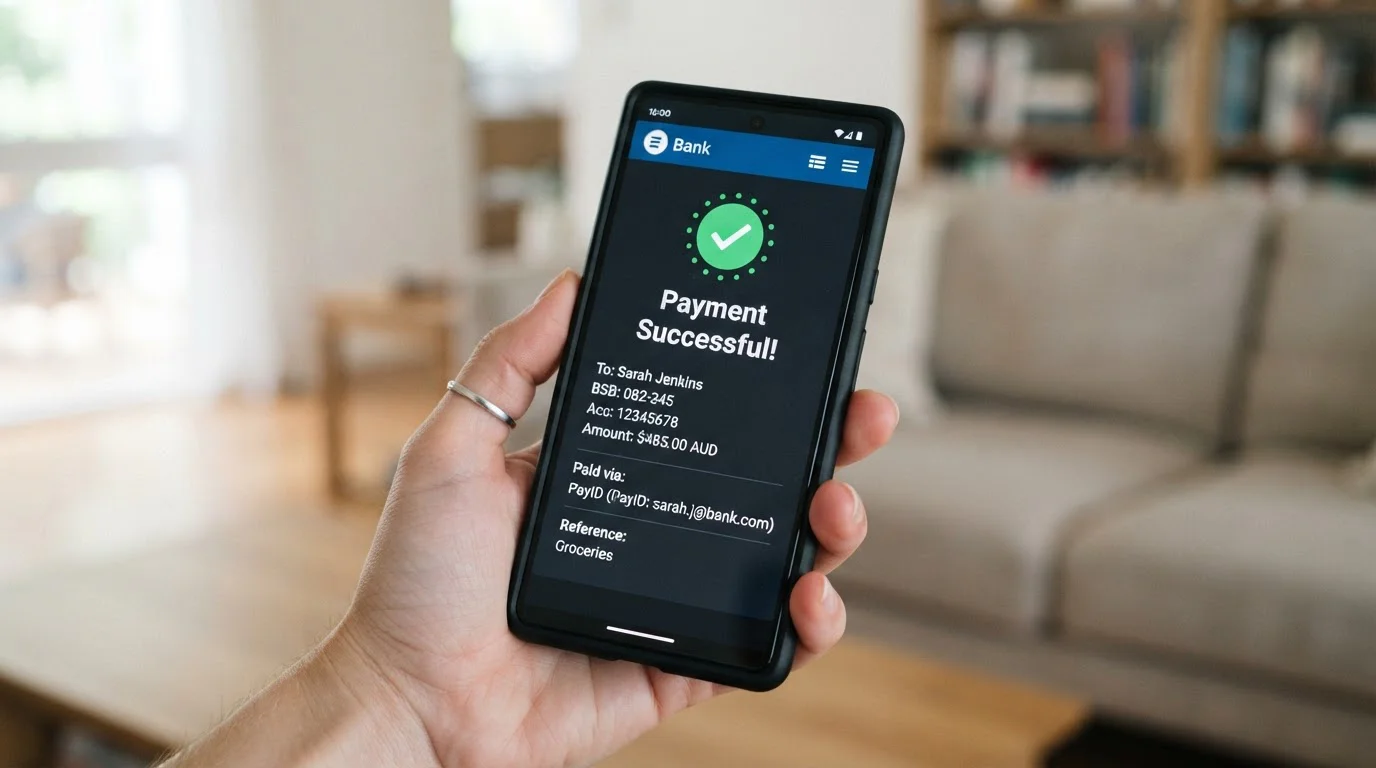
PayID is the reason most Australian-facing offshore casinos advertise a five-dollar minimum at all. Before PayID became standard in the offshore cashier, the floor was $10 to $20 on cards and $20 to $50 on bank transfers. PayID changed the economics because it costs the casino nothing to process and settles in real time with no intermediary taking a clip.
PayID is not a payment company. It is a branded addressing layer for the New Payments Platform, which is the instant settlement rail built and operated by NPP Australia Ltd. You link your bank account to an identifier — email, mobile number, ABN — and the system routes payments to your account without needing a BSB and account number. For a casino cashier, that means instant confirmation, zero chargeback risk, and no gateway fees beyond what their bank charges for receiving NPP transactions.
For a player, PayID means your $5 lands in full. No currency conversion spread, no payment processor fee, no “convenience charge.” You approve the payment in your banking app, the casino sees it within seconds, and your balance updates. Withdrawals work the same way in reverse: the casino pushes a PayID payment to your registered identifier, NPP settles it in real time, and the money appears in your account anywhere from 11 minutes to four hours later depending on whether the casino queues withdrawals for manual review or automates the whole pipeline.
The minimum deposit via PayID at the casinos on this list ranges from $5 to $20 depending on the operator. SkyCrown lists $20, Royal Reels lists $10, and most of the rest sit at $5. That variance is purely casino policy, not a PayID limitation — the NPP infrastructure handles any amount. The same is true for withdrawals. Minimum cashout at most of these brands is $30, but the PayID rail itself has no floor. That $30 figure is the casino’s risk threshold, not a payment-system constraint.
PayID works 24/7 including weekends and public holidays because NPP settlement never stops. That is a meaningful difference from card withdrawals, which often queue over weekends and only process on business days. For a five-dollar test deposit, PayID is the only method that gets your money into play instantly without fees and gives you a realistic shot at a same-day withdrawal if you hit something.
How PayID Works for $5 Deposits
Open the casino cashier, pick PayID as your deposit method, enter $5 as the amount. The casino displays a PayID identifier — usually an email address or mobile number registered to their business account. Switch to your banking app, select Pay Anyone or Send Money, enter the casino’s PayID identifier, enter $5, and approve the transaction. The payment goes through NPP’s instant settlement, the casino’s bank receives it in seconds, and the casino credits your balance.
No account setup on the payment side. No e-wallet, no voucher, no card authorization. Your existing bank account does all the work, and the casino sees the money before you close the banking app.
PayID Withdrawal Speed Reality
Stated processing times for PayID withdrawals at these offshore casinos run from two to four hours on average, with some automated cashiers settling in under an hour. The 11-minute payout at SkyCrown is an outlier at the fast end. Four hours is still faster than card withdrawals, which often take one to three business days, and much faster than international wire transfers, which can queue for a week.
Withdrawal speed depends on three things: whether the casino requires manual KYC approval before the first payout, whether the cashier queues withdrawals for anti-fraud review, and whether the casino actually has liquidity sitting in an Australian bank account to push the PayID payment from. That last point matters more than most players realize. A casino with an Australian-domiciled bank account can send a PayID payment instantly. A casino routing payouts through a foreign payment processor has to convert funds, move them to an Australian correspondent bank, then initiate the PayID transfer. That adds hours or days depending on the processor.
If a casino lists PayID as a withdrawal method and consistently delivers sub-four-hour settlement, it almost certainly operates an Australian bank account. If PayID withdrawals take longer than 24 hours, the casino is either manually reviewing every payout or routing funds through a third party. Either way, a test withdrawal from a five-dollar session tells you which one you are dealing with.
Which Casinos Accept PayID at $5
Every casino in the comparison table above lists PayID support, but the actual $5 floor varies. Royal Reels confirmed $10 via PayID with higher minimums on other methods. SkyCrown lists $20 as the PayID minimum. Spinjo, SpinsUp, 21bit, 7Bit, Katsubet, Spin Samurai, Goldenbet, Millioner and Rocket Play all appear in sources that cite $5 PayID acceptance, though Rocket Play has conflicting minimum-deposit figures depending on the source. Nitrobet is listed as accepting $5 but provides no verification detail.
The safest assumption: if a site advertises a $5 minimum, that figure applies to PayID and possibly crypto, with cards and other rails sitting at $10 to $20. Check the cashier before funding to confirm which method actually hits the floor.
Is PayID the best way to deposit $5?
Yes, in Australia. PayID lands the full five dollars instantly with no fees, works 24/7, and supports withdrawals at most offshore casinos in two to four hours. Cards usually impose a $10 to $20 minimum, and Bitcoin network fees eat 20 to 60 percent of a $5 deposit.
Which payment methods accept $5 deposits in Australia?
PayID reliably accepts $5 at most offshore casinos targeting Australians. Neosurf vouchers start at $10 in Australia, though partial redemption may allow $5 at some sites. Credit and debit cards typically require $10 to $20. Bitcoin technically supports any amount but network fees make $5 uneconomical.
Minimum Withdrawals — The $5 Deposit’s Real Constraint
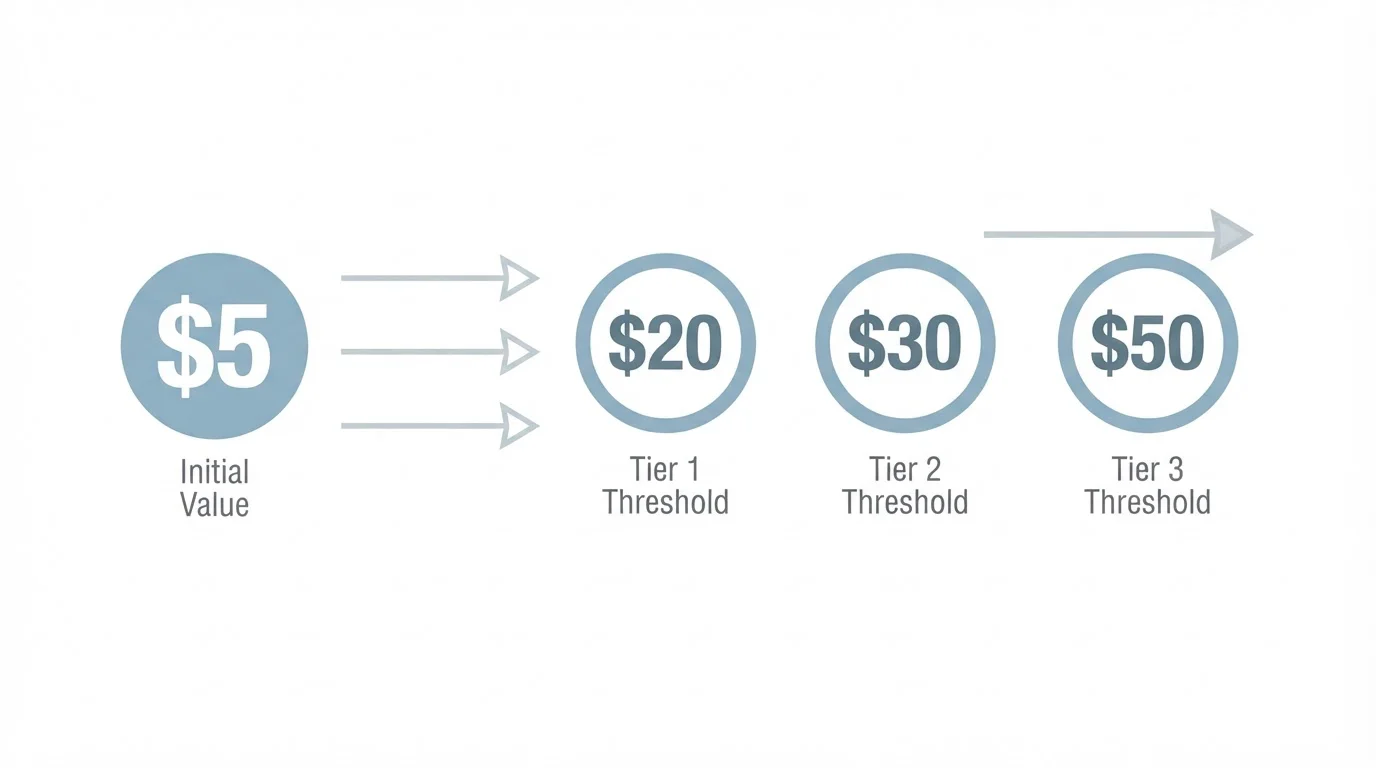
The $5 deposit is not constrained by what you can put in. It is constrained by what you need in your balance before you can take anything out. Every offshore casino sets a minimum withdrawal threshold, and every one of them sets it well above five dollars. The standard floor is $20 to $30 for PayID and bank transfers, $25 to $50 for cards, and $30 to $100 for crypto depending on the operator and the coin.
Run the maths on that. A $5 deposit at a $20 withdrawal minimum means your balance must grow fourfold before you can request a payout. At $30, six times. At $50, ten times. At $100 — which some crypto-only brands still enforce — you need to turn five dollars into a hundred, a 20× multiplier. On a 96% RTP pokie, that outcome sits somewhere between “unlikely” and “not happening unless you catch a bonus-round streak.”
The reason casinos set withdrawal minimums this high is transaction cost. Processing a payout costs the operator money — KYC review time, payment gateway fees, compliance checks, customer support load if something goes wrong. A $5 or $10 withdrawal does not cover those costs, so the operator loses money on the transaction. By setting the floor at $20 or $30, the casino ensures that every withdrawal at least breaks even on processing cost, and ideally the player has wagered enough by that point to cover their share of the house edge.
For a player, that minimum withdrawal is the real gate. Spin count, RTP, volatility — all of that matters, but none of it matters if you never reach the threshold to request a payout. And most five-dollar deposits do not. They either drain to zero through normal variance or grow to $10 or $15 before the next cold streak pulls them back under. The ones that make it past $30 are rare enough that they feel like wins even when the net result is a $25 profit on an hour of play.
The withdrawal minimum is also the reason a $5 deposit is correctly described as a test stake. You are not funding a session with an expectation of profit. You are buying access to the casino’s payout pipeline at the smallest scale it will process. If the $5 turns into $35 and you request a withdrawal and it lands in your account in four hours, you now know that casino is functional. If it turns into $12 and you lose it back, you spent five dollars to find out the games run cleanly and the cashier does not throw errors. That information has value, and it costs a lot less than depositing $100 on faith.
What’s the minimum withdrawal amount if I deposit $5?
$20 to $30 via PayID and bank transfers at most offshore casinos, $25 to $50 on cards, and $30 to $100 on crypto depending on the operator. A $5 deposit must grow four to twenty times before you can request a payout.
What happens if I win from a $5 deposit — can I withdraw it?
Only if your balance reaches the casino’s minimum withdrawal threshold, typically $20 to $50. Anything below that cannot be cashed out. You either play it back through, deposit more to reach the threshold, or forfeit it.
Which Pokies Work with a $5 Bankroll

A $5 bankroll does not work with every pokie. High-volatility titles like Dead or Alive 2 or Bonanza Megaways will chew through five dollars in under ten spins if you are running the standard $0.50 to $1 stake most players default to. The variance is too wide and the dry spells too long for a micro stake to survive. What does work: low-to-medium volatility pokies with minimum bets under $0.20 and RTPs above 96%.
Low volatility means smaller swings. You will not hit a 5,000× jackpot spin, but you will not dead-spin ten times in a row either. The wins come smaller and more frequently, which stretches your spin count and gives you more chances to land a feature round that actually pays something. Medium-volatility sits in between — occasional big hits, occasional dead runs, and enough base-game action to keep a session moving.
RTP matters more at micro stakes than it does at $100 deposits because you have no buffer to absorb house-edge grind. A 94% RTP pokie costs you six cents per dollar wagered over the long run. A 96% RTP pokie costs four cents. On a $5 bankroll, that two-percentage-point difference is the difference between 30 spins and 40 spins before you hit zero. That might not sound like much, but when your entire session is 50 spins, every extra pull matters.
Minimum bet size is the third filter. Most modern pokies from Pragmatic Play, Play’n GO, NetEnt and Microgaming sit at $0.10 to $0.20 as their floor. A few older titles or branded slots impose $0.20 to $0.50 minimums. At $0.10 per spin, $5 gives you 50 spins before losses. At $0.20, 25 spins. At $0.50, ten spins. You want to be in the $0.10 to $0.20 range for a five-dollar session to feel like a session rather than a blink.
Here are five pokies that fit the profile: low to medium volatility, 96%-plus RTP, and minimum bets at or under $0.20.
| Pokie | Provider | RTP | Volatility | Min bet | Spins from $5 at min bet |
|---|---|---|---|---|---|
| Starburst | NetEnt | 96.09% | Low | $0.10 | 50 |
| Big Bass Bonanza | Pragmatic Play | 96.71% | Medium-high | $0.10 | 50 |
| Blood Suckers | NetEnt | 98.00% | Low | $0.25 | 20 |
| Jack Hammer | NetEnt | 96.96% | Low-medium | $0.50 | 10 |
| Gonzo’s Quest | NetEnt | 95.97% | Medium | $0.20 | 25 |
Starburst is the default low-volatility pick for a reason. Wins hit often, the 10-payline structure is simple, and the expanding wilds trigger regularly enough that you rarely dead-spin more than five or six times in a row. The RTP is mid-range at 96.09%, but the low variance keeps the session alive longer than the RTP alone would suggest.
Big Bass Bonanza sits at medium-high volatility, which makes it a riskier pick for $5, but the 96.71% RTP and the $0.10 minimum bet give it a spot on the list. The base game is dry, but the free spins feature pays well when it lands, and the $5 bankroll is enough to survive the wait if you are betting minimum.
Blood Suckers has the highest RTP on this list at 98%, which is almost unheard-of in online pokies. The two-percent house edge is lower than most blackjack tables. The minimum bet is $0.25, which cuts your spin count to 20, but the low volatility and high RTP mean those 20 spins stretch further than they would on a 94% game. The downside is the max win is capped low — this is not a jackpot chaser, it is a grinder.
Jack Hammer is low-to-medium volatility with a 96.96% RTP and sticky-win mechanics that chain small hits into medium ones. The minimum bet is $0.50, which gives you only ten spins from $5, but the sticky-win structure means those spins often generate follow-up wins without consuming extra balance. It is a high-variance way to play a low-variance game.
Gonzo’s Quest is medium volatility with an avalanche mechanic that chains wins and builds multipliers. The 95.97% RTP is below the 96% threshold, but the $0.20 minimum bet and the avalanche structure give you 25 spins that feel more interactive than Starburst’s static paylines. Gonzo’s is better for a $10 or $20 bankroll, but it works at $5 if you are comfortable with the variance.
The pattern across all five: minimum bets at or under $0.25, RTPs at or above 96% except Gonzo’s, and volatility low enough that a cold streak does not eat your entire bankroll in eight spins. Avoid anything with “Megaways” in the title on a $5 stake — those mechanics are built for high-variance action and $1-plus spins, not micro-stake grinding.
Low Volatility Pokies for $5 Sessions
Starburst, Blood Suckers, and Jack Hammer are the cleanest low-volatility picks. Starburst is the most forgiving on a $5 bankroll because the $0.10 minimum bet and frequent small wins stretch your session to 40 or 50 spins even after house-edge losses. Blood Suckers has the highest RTP at 98% but forces a $0.25 minimum, which halves your spin count. Jack Hammer’s sticky-win mechanic chains hits together, but the $0.50 minimum cuts you to ten spins, so it is a boom-or-bust option.
RTP Matters More at Micro Stakes
On a $100 deposit, the difference between 94% RTP and 96% RTP is $2 over the course of your session. On a $5 deposit, that difference is ten cents, which at $0.10 per spin is one extra pull. At micro stakes, every percentage point of RTP translates directly into spin count, and spin count is what separates a five-minute session from a fifteen-minute one. Stick to 96% or higher unless the game’s volatility is low enough to compensate.
Minimum Bet Sizes to Look For
$0.10 to $0.20 per spin is the sweet spot for a $5 bankroll. At $0.10, you get 50 theoretical spins before losses. At $0.20, 25 spins. At $0.50, ten spins, and variance will almost certainly cut that in half. Modern pokies from NetEnt, Pragmatic Play, Play’n GO and Microgaming mostly land in the $0.10 to $0.20 range, but always check the bet slider before you start spinning. Some branded titles and older slots impose $0.50 or $1 minimums, which kill a micro stake in minutes.
How many spins do I get with a $5 deposit?
10 to 50 spins depending on the pokie’s minimum bet. At $0.10 per spin, $5 gives you 50 spins before variance and house edge reduce the count. At $0.50 per spin, ten spins. Stick to low-volatility pokies with $0.10 to $0.20 minimums to maximize session length.
Bonus Eligibility at $5 — The Uncomfortable Truth

Most offshore casinos gate their welcome bonuses above five dollars. The typical threshold is $10 to $20 as the minimum qualifying deposit, which means a $5 deposit lands in your account as cash balance only — no matched funds, no free spins, no bonus ticker running in the corner of the screen. The casino accepts the five dollars because it gets you into the game lobby and starts the behavioral loop of depositing, playing, losing, depositing again. But it does not pay you to do it.
The ones that do trigger a bonus at $5 usually attach conditions that make the offer less valuable than it looks. A 100% match on a $5 deposit gives you $10 total to play with, but the wagering requirement still applies to the $5 bonus portion. At 40× wagering, you need to spin $200 through the pokies before any winnings become withdrawable. On a $10 total balance. Run that scenario: you start with $10, the house edge pulls four percent of every dollar you wager, and you need to cycle $200 through the reels without hitting zero. That outcome is so unlikely that the bonus might as well not exist.
The few brands that advertise “$5 deposit bonuses” are usually running time-limited promotions aimed at getting you in the door. The bonus itself is either a handful of free spins on a single title with a win cap, or a small matched percentage with a low max bonus and steep wagering. One common structure: 50% up to $10 bonus at 50× wagering. That translates to $7.50 bonus on a $5 deposit, requiring $375 in total wagers to clear. It is technically a bonus. It is not a functional one.
What a $5 deposit does not get you at most casinos: the first-stage welcome package, the 100% or 200% match that actually adds playable balance, the 50 or 100 free spins that might land a win without touching your cash. Those offers kick in at $10, $20 or $25 depending on the brand, and they are structured to deliver enough extra balance to survive the wagering requirement and still walk away with something. A $5 bonus is structured to expire.
The smarter play on a five-dollar test deposit is to skip the bonus entirely. Deposit the $5 as cash, play it without wagering restrictions, and if you hit something, withdraw it as soon as you reach the minimum threshold. No playthrough, no max win cap, no bonus terms buried in fourteen paragraphs of fine print. You get less starting balance, but every dollar you win is yours.
For the few casinos that do honor a $5 bonus, read the terms before you click the opt-in box. Check the wagering multiplier, check the max bet allowed while the bonus is active, check the win cap, and check which games contribute to wagering. If the wagering requirement is above 40× or the win cap is below $100, you are better off without it.
Will a $5 deposit trigger the welcome bonus?
At most offshore casinos, no. Welcome bonuses typically require a $10 to $20 minimum deposit. The few sites that do offer a $5 bonus usually attach wagering requirements so steep — 40× to 50× — that clearing them on a $5 or $10 total balance is effectively impossible. Skip the bonus and play the $5 as cash.
The Legal Reality — No Australian License Exists

Australia does not license online casinos. That is not an oversimplification or a technicality. The Interactive Gambling Act 2001 makes it an offence for any company to provide real-money online gambling services — pokies, table games, live dealer, anything beyond sports betting and lotteries — to a person physically located in Australia. No Australian state or territory has the authority to issue a casino licence that overrides the federal prohibition. No local regulator maintains a whitelist of approved offshore sites. No legal framework exists to bring offshore operators into a licensed, consumer-protected domestic market.
Every pokie site an Australian can sign up to is offshore. Curaçao, Malta, Kahnawake, Anjouan, Gibraltar, Isle of Man — jurisdictions that license online casinos to operate globally and let them accept Australian players at their own discretion. The Interactive Gambling Act makes it illegal for the operator to provide the service, not for the player to use it. That distinction is important. An Australian playing at an offshore casino is not committing a crime. The casino offering the service to them is. But because the casino operates outside Australian jurisdiction, the penalty is unenforced.
The Australian Communications and Media Authority enforces the IGA by blocking domains. Since November 2019, ACMA has blocked over 1,564 illegal gambling sites and pushed 225-plus offshore services to withdraw from the Australian market voluntarily. The blocks target unlicensed sports betting operations more aggressively than online casinos, but both fall under the same framework. A blocked domain does not shut down the casino. It just forces the operator to spin up a new domain or rely on affiliates to direct Australian traffic to mirror sites.
The Gambling Reform Bill passed 19 August 2026 and takes effect 1 January 2026+1. It strengthens BetStop, the national self-exclusion register, and gives ACMA new powers to compel banks to block payments to illegal gambling operators. That is a meaningful change. Up until now, ACMA could block domains but could not touch the payment pipeline. Starting January 2026+1, if ACMA identifies an offshore casino operating illegally in Australia, it can direct Australian banks to refuse transactions to that operator. Whether that kills the offshore market or just pushes it further into crypto rails is the open question.
What did not change: online casino licensing. The 2026 amendments do not create a pathway for offshore casinos to apply for Australian licenses. They do not establish a whitelist of approved sites. They do not legalize the twelve brands in the comparison table above. All of those casinos remain illegal under the IGA, and all Australian players using them remain in a legal grey zone where the use is not criminal but is also not protected.
Interactive Gambling Act 2001 Explained
The IGA prohibits Australian-based companies from offering online casino games to Australian residents. It does not prohibit Australians from playing at offshore sites. That gap means offshore casinos can accept Australian players without facing Australian criminal prosecution because they operate outside Australian jurisdiction. The operator commits the offence under Australian law, but the law does not reach the operator.
The 2026 Gambling Reform Amendments
Passed 19 August 2026, effective 1 January 2026+1. Key measures: betting advertising restrictions, BetStop strengthening, bank blocking powers for ACMA, bans on online keno and foreign-matched lotteries, clarified trade promotion services regulation. Does not legalize online casinos. Does not create licensing pathways. Offshore casinos remain illegal, and banks may be compelled to block payments to them starting January 2026+1.
What Offshore Licensing Actually Means
Offshore licensing means the casino holds a permit issued by a foreign jurisdiction that allows it to operate an online gambling business globally. Curaçao is the most common licence among Australian-facing brands because it is cheap, fast to obtain, and rarely revoked. Malta and Kahnawake are stricter but more expensive. Anjouan and other small-island jurisdictions issue licenses with minimal oversight. None of these licences are recognized by Australian law. A Curaçao licence does not make a casino legal in Australia. It just means the casino is licensed somewhere.
Consumer Protection Gap
Because no Australian regulator licenses offshore casinos, no Australian regulator handles complaints about them. If a withdrawal is delayed, if a bonus is voided, if an account is frozen, Australian consumer protection law does not apply. The only recourse is the licensing jurisdiction’s regulator, which in the case of Curaçao means emailing an understaffed office that processes maybe one dispute in fifty. The casino’s terms of service govern the relationship, and those terms almost always include an arbitration clause that waives your right to sue.
That gap is the cost of playing offshore. You trade consumer protection and legal recourse for access to games that are illegal to provide domestically. Some players are fine with that trade. Others are not. Either way, the gap is real, and pretending an offshore casino with a Curaçao licence is “safe” because it has a licence misses the point. The licence does not protect you. It protects the casino from prosecution in its home jurisdiction.
Are $5 deposit pokies legal for Australian players?
Australian law does not criminalize individual players using offshore online casinos. The Interactive Gambling Act 2001 makes it illegal for operators to provide casino games to Australians, but enforcement targets the operator, not the player. All $5 deposit pokies sites accepting Australians are offshore and unlicensed in Australia.
Other Payment Methods at $5 — Cards, Crypto, Neosurf
PayID is the cleanest $5 rail, but it is not the only one. Cards, crypto and Neosurf all technically support five-dollar deposits, though each comes with caveats that make them less practical than PayID in most cases.
Credit and Debit Cards
Visa and Mastercard are listed in the cashier at every offshore casino targeting Australians. The stated minimum deposit is usually $10 to $20, occasionally $5 if the casino is trying to hit a low-floor marketing claim. In practice, $5 card deposits often fail at the authorization stage because the card issuer flags small international gambling transactions as fraud. Even when the authorization goes through, some casinos add a processing fee — one to three percent — which eats into the $5 before it hits your balance.
Card withdrawals are worse. Minimum cashout on cards sits at $25 to $50 at most offshore brands, and processing takes one to three business days. Visa and Mastercard both prohibit gambling transactions in certain jurisdictions, which means your withdrawal might land or it might bounce depending on whether the casino’s payment processor routes it as a gambling transaction or disguises it as something generic. That uncertainty is why cards are falling out of favor at offshore casinos. Players who use cards for deposits usually switch to PayID or crypto for withdrawals.
Cryptocurrency Reality
Bitcoin, Ethereum, Tether, Litecoin — all of them support deposits well below five dollars at the protocol level. The problem is network fees. A Bitcoin transaction costs between $1 and $5 depending on network congestion. Ethereum is similar or higher when gas fees spike. Sending $5 in Bitcoin means $1 to $3 of it gets eaten by miner fees, leaving you with $2 to $4 in playable balance. That is a 20 to 60 percent loss before you place a single bet.
Stablecoins like Tether (USDT) on the Tron network have lower fees — often under $1 — but you still lose 10 to 20 percent of a $5 deposit to transaction costs. Crypto makes sense at $50 or $100 deposits where the fee is a small percentage of the total. At $5, the fee is the transaction.
Crypto withdrawals are fast when they work. Most offshore casinos process Bitcoin and Ethereum payouts in minutes to a few hours, and the settlement is irreversible once it hits the blockchain. But minimum crypto withdrawals sit at $30 to $100 depending on the casino and the coin, and the casino often adds its own withdrawal fee on top of network fees. For a five-dollar test deposit, crypto is the wrong tool.
One more complication: some sources claim cryptocurrency deposits were banned at Australian-facing casinos starting June 2024. That claim is not universal and may refer to specific operators pulling crypto rails under regulatory pressure rather than a blanket ban. As of 2026, multiple brands on the comparison list still accept crypto from Australian players. Verify the cashier before assuming crypto is available.
Neosurf Vouchers
Neosurf is a prepaid voucher system sold at newsagents, petrol stations and convenience stores across Australia. Vouchers come in fixed denominations: $10, $20, $50, $100 AUD. You buy the voucher, scratch off the code, enter it in the casino cashier, and the value loads to your balance. No bank account, no card, no identity verification at the point of purchase.
The catch: Neosurf vouchers in Australia start at $10. There is no $5 voucher. Some casinos allow partial voucher redemption, meaning you can use $5 of a $10 voucher and save the remaining $5 for another transaction. Others force you to redeem the full voucher at once. Either way, you are buying a $10 voucher to make a $5 deposit, which defeats the point of testing at the smallest scale.
Neosurf withdrawals do not exist. The voucher is deposit-only. Winnings have to come out via bank transfer, PayID or crypto, so even if you fund the account with Neosurf, you still need to link a withdrawal method. For a five-dollar test, Neosurf is workable if you already have a voucher sitting in a drawer, but buying one specifically for a $5 deposit is backwards.
| Method | True minimum | Net deposit after fees | Speed | Availability at $5 casinos |
|---|---|---|---|---|
| PayID | A$5 | A$5.00 (zero fees) | Instant | Standard at all brands |
| Cards | A$10–A$20 | A$4.75–A$19.50 (1-3% fees) | Instant to 24 hours | Rare at $5, common at $10+ |
| Bitcoin | No floor (protocol) | A$2–A$4 ($1–$3 network fee) | 10 min to 1 hour | Supported but uneconomical |
| Neosurf | A$10 (voucher minimum) | A$5–A$10 (partial redemption) | Instant | Some casinos, voucher-only |
PayID wins on every axis except one: it requires a bank account. If you do not have an Australian bank account, Neosurf is the best cash-based alternative, but you are paying $10 to deposit $5 unless the casino supports partial voucher redemption. Cards work at $10-plus deposits but rarely at $5. Crypto is technically possible but financially silly at micro stakes.
New $5 Deposit Casinos in 2026
Most of the brands in the comparison table launched between 2022 and 2024, which makes them “new” by offshore casino standards but not bleeding-edge. SpinsUp launched in 2024 and is the newest entrant with a $5 floor. Spinjo and 21bit both launched in the 2022 to 2023 window. Royal Reels appeared in Australian affiliate lists around 2023. The rest predate 2022, with 7Bit going back to 2014.
New casinos offer two advantages: fresh welcome bonuses trying to grab market share, and modern cashier infrastructure that actually supports PayID and crypto from day one instead of bolting it on later. The disadvantage is thin track record. A brand that launched six months ago has not yet faced a regulatory crackdown, a payment-processor pullout, a liquidity crunch, or a wave of withdrawal complaints. You do not know if it pays out cleanly until it has been tested under stress.
Older brands like 7Bit and SkyCrown have survived multiple years in the Australian offshore market, which means they have managed licensing renewals, payment-processor turnover, ACMA blocking attempts, and shifts in banking policy without folding. Longevity is not a guarantee of quality, but it is a signal that the operator knows how to keep the lights on.
For a five-dollar test deposit, older brands are the safer pick. If you are depositing $100 or $200 and chasing a large welcome bonus, a new casino with a 200% or 300% match might be worth the risk. But when you are testing at the smallest scale, you want the operator least likely to invent a reason to void your $30 withdrawal.
Responsible Gambling and When to Stop

A five-dollar deposit is small enough that it is easy to dismiss the risk. It is five dollars. You spend more on a coffee. But the five-dollar deposit is not the risk. The risk is what happens after you lose the five dollars and decide to try again with twenty, or fifty, or two hundred, because now you know the site works and the cashier is fast and maybe this time the pokies pay back.
That is how five-dollar test deposits turn into thousand-dollar problems. Not in a single session. Not even in a single week. But across three months of Friday-night sessions where the $5 becomes $20, the $20 becomes $50, and the $50 becomes $200 when you hit a bad weekend and convince yourself you can win it back. The offshore casinos know this. That is why they accept five-dollar deposits in the first place. It is a foot in the door.
If a $5 deposit turns into regular $20 or $50 deposits, or if you find yourself depositing again within an hour of losing the first stake, that is the inflection point. Not addiction yet, but the pattern forming. The earlier you catch it, the easier it is to stop.
BetStop National Self-Exclusion Register
BetStop is the national self-exclusion register for online gambling in Australia. Register once, and you are excluded from all licensed Australian betting and lottery operators. The problem: BetStop does not cover offshore casinos. It only applies to operators licensed in Australia, and no offshore pokies site holds an Australian licence. That means BetStop does nothing to block your access to the twelve brands in the comparison table above.
You can still use BetStop to block yourself from licensed sports betting and lotteries, which removes those options if they are part of your gambling pattern. But for offshore casinos, BetStop is not the tool. Most offshore brands offer their own self-exclusion systems, but those are per-site. Excluding yourself from SkyCrown does not exclude you from Spinjo or 21bit. You have to go through each cashier separately, and nothing stops you from signing up at a brand you have not excluded yourself from yet.
The lack of coverage is not an oversight. BetStop is administered by the Australian government and enforced under domestic law. Offshore casinos operate outside Australian jurisdiction, so Australian law cannot compel them to integrate with BetStop. Some offshore operators voluntarily participate in multi-operator exclusion schemes like GAMSTOP in the UK, but those schemes are rare in the Curaçao-licensed space.
If you need a hard stop on offshore pokies, the only effective tool is payment-level blocking. Ask your bank to block gambling transactions, or use a payment-blocking app that intercepts card authorizations and PayID payments to known gambling merchants. Neither is perfect, but both work better than hoping an offshore casino honors a self-exclusion request.
Gambling Help Services
Gambling Help is the national helpline: 1800 858 858, 24/7. The service is free and confidential, and it connects you to trained counselors who can walk you through self-exclusion, budget management, and local support services. If you are reading this section because you recognize the pattern in your own behavior, that number works. Calling it does not get recorded on any government file, does not get reported to your bank, and does not trigger any mandatory intervention unless you are a danger to yourself or others.
State-level services also exist. NSW runs GambleAware. Victoria runs Gambler’s Help. Queensland runs Gambling Help Queensland. Each state service offers face-to-face counseling, financial counseling, and family support. All of them are free. The threshold for accessing them is not “I am an addict.” The threshold is “this is starting to feel like a problem.”
When $5 Stops Being a Test
A $5 deposit stops being a test when you are doing it three times a week, or when you are depositing $5 to “just check” whether your luck has changed since yesterday, or when you are funding the $5 from money that was supposed to cover something else. The dollar amount is not the signal. The frequency and the justification are the signals.
If you catch yourself thinking “I will deposit $5, and if I lose it I am done” and then you lose it and deposit again ten minutes later, that is when the $5 test has stopped being a test. The offshore casinos are built to turn tests into habits. The five-dollar floor is not there to help you. It is there to lower the friction on the first transaction so the second and third and tenth transactions feel smaller.
Minimum Deposit Casinos Australia 2026 — $1, $2, $5, $10, $20
Content created by the «AussieChips» team
