
Anonymous Crypto Casino Australia: The Honest Guide to Playing Without ID
 Available in US

The gambling industry spent a decade convincing you that cryptocurrency equals privacy. By 2026, that story needs revision. You can deposit Bitcoin without showing a passport, play pokies with an email address, and withdraw to a wallet the casino never formally linked to your name. That part is real. But the blockchain you just used keeps a permanent, public record of every transaction. The platform you trusted with your balance reserves the right to freeze your account and demand documents before you touch your winnings. And the Australian government considers the operator illegal while leaving you, the player, untouched by enforcement.
Anonymous crypto casinos accepting Australians in 2026 exist in a specific structure. They are offshore, unlicensed in Australia, and operating in jurisdictions that ask fewer questions than Malta or the UK. You trade regulatory protection for reduced data collection. That trade has a price, and understanding the price is the only way to make an informed decision about whether to pay it.
This guide covers eight platforms that Australian players can access, what each requires for signup and withdrawal, where the privacy boundaries actually sit, what the legal position is under the Interactive Gambling Act, and how to stay safe when the only safety net is the one you build yourself. No affiliate marketing, no “best bonus” rankings. Just the structure of anonymous crypto gambling in Australia as it exists in 2026.
What “Anonymous” Actually Means at Crypto Casinos
Start with the terminology. When a crypto casino calls itself “anonymous,” it means you can register with an email address and a password, deposit cryptocurrency from your wallet to a casino-generated address, play, and withdraw back to your wallet without uploading a passport photo or a utility bill at the point of signup. That is the extent of the promise, and it is a meaningful reduction in friction compared to a regulated casino that demands government ID before you deposit a cent.
But “anonymous” is doing heavy lifting in that sentence, and the weight it carries depends on what you think it means. A Bitcoin transaction is not anonymous. It is pseudonymous. Every transaction you make is recorded on a public blockchain that anyone can inspect. Your wallet address is visible. The casino’s wallet address is visible. The amount you sent is visible. The time you sent it is visible. If that wallet address is ever linked to your real identity—because you bought Bitcoin through an exchange that required KYC, or because you reused the same wallet for a transaction that did require identification—your entire gambling history becomes retrospectively transparent.
True anonymity at a crypto casino requires operational security on your end. A dedicated wallet used only for gambling and funded through no-KYC methods. A VPN or Tor to mask your IP address. A browser profile or virtual machine that does not carry your usual digital fingerprint. Privacy coins like Monero, if the platform supports them. Most players do not take these steps. Most players use the same wallet they bought Bitcoin through on Coinbase, access the site from their home internet connection, and assume “anonymous” means the casino does not know who they are. The casino might not know your name, but your entire transaction history is on a public ledger, and linking that ledger to you is a trivial exercise for anyone with access to exchange KYC data or blockchain analytics tools.

The second misunderstanding is around verification. “No KYC” at signup does not mean “never KYC.” Every platform reserves the right to request identity documents before processing a withdrawal. The trigger varies. Some platforms, like Stake, require verification upfront before your first cashout. Others, like BC.Game, let you withdraw up to a monthly cap (€10,000, dropping to €5,000 if your balance exceeds ten times your deposits) before demanding documents. Rollbit reportedly triggers around $2,000 in cumulative withdrawals or $10,000 in monthly wagering. BetPanda is lighter, with reports of verification near $2,000 but inconsistent enforcement. The point is that “anonymous” in this space means “anonymous until a threshold,” not “anonymous forever.”
Can you really gamble anonymously at crypto casinos in Australia?
You can gamble with reduced personal data collection. You cannot gamble in a way that leaves no trace. The blockchain is a public ledger. Your wallet address, transaction amounts, and timestamps are visible to anyone. If that wallet is linked to your identity elsewhere—through an exchange, a prior purchase, or any other touchpoint—your gambling activity is no longer anonymous. The casino itself might not collect your ID at signup, but the infrastructure you rely on (exchanges, blockchain analytics, ISPs) can link you to your activity. True anonymity requires dedicated wallets, privacy coins, and operational security most casual players never implement.
What does “no KYC” actually mean at anonymous crypto casinos?
No KYC at signup. Potential KYC at withdrawal. Every platform covered here allows email-and-password registration without uploading documents. Where they differ is the threshold at which they demand verification. Stake requires it upfront. BC.Game lets you withdraw up to €10,000 a month unverified. Rollbit triggers around $2,000 cumulative or $10,000 monthly wagering. BetPanda is the lightest but still reserves the right to request documents. “No KYC” is a spectrum, not a binary. Read the terms, understand the threshold for the platform you choose, and know that a large win can turn “no questions asked” into “send us your passport or your balance stays frozen.”
8 Anonymous Crypto Casinos That Accept Australians
The platforms below are offshore, unlicensed in Australia, and illegal-to-supply under the Interactive Gambling Act 2001. Using them as an Australian player is not an offence—the law targets operators, not punters, and zero player prosecutions exist on record—but you have no regulatory recourse if a dispute arises. The trade is explicit: reduced data collection, zero consumer protection.
Each entry below details what the platform requires for signup, the documented or reported KYC threshold, withdrawal speed, supported cryptocurrencies, and what distinguishes it from the others. The order is set for the privacy-first reader: strongest privacy first, lightest verification requirements leading.
| Platform | Primary Cryptos | KYC Threshold | Withdrawal Speed | Key Feature |
|---|---|---|---|---|
| BetPanda | BTC (incl. Lightning), ETH, USDT, 10+ | ~$2k (inconsistent) | Instant | Email-only, VPN-friendly, Lightning Network |
| BC.Game | 100+ (BTC, ETH, DOGE, USDT, alts) | €10k/month (€5k if big winner) | Instant to 1h | 100+ cryptos, first-withdrawal check (2026) |
| Rollbit | BTC, ETH, LTC, USDT, RLB | ~$2k withdrawal OR $10k wagering | Instant to 30 min | No ID to start, VPN explicitly banned |
| CoinCasino | BTC, ETH, LTC, DOGE, USDT | Meaningful withdrawals (unpublished) | 10-30 min | Telegram play, no-KYC deposit |
| Cloudbet | BTC, ETH, USDT, BCH, LTC, DOGE | First withdrawal + large amounts | Instant (BTC) | Established 2013, high-roller focus |
| mBit Casino | BTC, ETH, LTC, DOGE, USDT, BCH, TRX | ~$2k-$5k (industry standard) | Within 10 min | VIP program, long-running (2014) |
| Lucky Block | BTC, ETH, USDT, LTC, DOGE, XRP | Large withdrawals (unpublished) | Instant to 1h | Integrated sportsbook, high limits |
| Stake | BTC, ETH, LTC, DOGE, TRX, USDT, XRP, BCH | KYC upfront (before any withdrawal) | <1h | Unlimited withdrawals, fast payouts, not truly “no-KYC” |
BetPanda — Email-Only, Lightning Network
BetPanda is the strongest privacy play on this list and the riskiest from a recourse standpoint. It is registered in Costa Rica with no gambling license, which means no regulatory oversight and no authority to escalate a dispute to if things go wrong. What it offers in exchange is email-only signup that accepts disposable addresses, explicit VPN tolerance, and Bitcoin Lightning Network support—instant, near-zero-fee BTC transactions that are rare among crypto casinos in 2026.
The platform states withdrawal limits of $5,000 per day, $15,000 per week, and $45,000 per month. KYC is reported to trigger near $2,000 in cumulative withdrawals, but enforcement is inconsistent. Support has stated that “small withdrawals don’t trigger” verification, which is as vague as it sounds. The honest read: BetPanda operates with discretion, not published rules, and that discretion swings both ways. You might withdraw $5,000 without a question, or you might be asked for documents at $500. The lack of a license means the lack of a rulebook, which is the entire point for privacy-focused players and the entire problem if a large balance gets frozen.
BetPanda suits players who prioritize privacy over regulatory protection, who keep balances modest, and who understand that zero oversight cuts both ways. The Lightning Network support is a practical advantage—sub-second confirmation, negligible fees—and the VPN-friendly stance is explicitly stated rather than quietly tolerated. But if you hit a big win and verification becomes a condition for withdrawal, you are negotiating with an entity that has no regulator to answer to and no track record of handling disputes in a way you can verify.
BC.Game — 100+ Cryptos, €10k Monthly Cap
BC.Game holds a Curaçao eGaming license and supports over 100 cryptocurrencies, making it the widest selection on this list. It also has the most transparent KYC policy, because the thresholds are written into the terms of service rather than left to guesswork. Section 8.6 caps unverified accounts at €10,000 in monthly withdrawals. If your balance exceeds ten times your deposits—the “big winner clause”—that cap drops to €5,000 per month. Section 8.3 states that photo ID, proof of address, and a selfie or verification call can be demanded before any payout and re-demanded at any later point.
The 2026 policy change added a first-withdrawal KYC trigger. You can deposit and play on an email-only signup, but the first time you request a cashout, a verification check is standard. If you pass that, you operate under the €10k or €5k monthly cap depending on your balance-to-deposit ratio. If you stay inside that range and avoid behavioral flags—rapid wallet rotation, timezone mismatches, suspected multi-accounting—BC.Game remains playable without further document requests. Cross the cap or trip a flag, and you are back in the verification queue.
The documented weak point is the selfie stage. A January 2025 case on BitcoinTalk detailed a 7,800 USDT withdrawal frozen when the automated check flagged the selfie for “AI tampering.” It took a public forum escalation to resolve in two days. The takeaway: the system can false-positive, and when it does, escalation is your only lever. BC.Game’s massive crypto variety (100+ coins, including reported native Monero support) and transparent threshold structure make it a strong choice for players who want to know where the line is rather than guess at it. The first-withdrawal KYC requirement as of 2026 makes it less “anonymous” than BetPanda but more predictable.
Rollbit — No ID to Start, $2k Trigger
Rollbit lets you register, deposit, and withdraw at Level 1 with no identity documents required. The question is how long that lasts. Three independent sources (datawallet.com, ltccasino.io, cryptotips.com) report automated KYC once cumulative withdrawals pass approximately $2,000 or monthly wagering passes $10,000. Rollbit’s own terms do not publish these figures, so treat them as observed behavior, not guaranteed rules.
The platform runs a five-level verification system. Level 2 is a photo of government ID and typically clears in minutes. Higher levels add proof of address and, in documented Trustpilot cases, source-of-funds paperwork such as bank statements or payslips. The deeper you go, the slower it gets. What distinguishes Rollbit from the others is the dual trigger: withdrawal amount and wagering volume. A grinder cycling small balances can cross $10,000 in monthly turnover without ever making a large cashout and still trip the verification wall. If anonymity is the goal, treat wagering volume as a budget, not just withdrawal size.
Rollbit explicitly bans VPN use. The terms list 29 blocked jurisdictions including Australia, the US, and the UK, and the platform uses IP-masking detection. Documented complaints describe account freezes and multi-account accusations leading to balance confiscations. The Trustpilot profile sits at 1.7 out of 5 across roughly 200 pages, with a recurring pattern: large account, verification demand, support silence, balance frozen. If you use Rollbit, you are rolling the dice on a platform with documented enforcement against VPN users and a low community trust score. The $2,000 threshold is workable for small-stakes players. The VPN ban and dispute history are not.
CoinCasino — Telegram Play, No-KYC Deposit
CoinCasino, established in 2014, holds a Curaçao license and offers a feature rare among crypto casinos: Telegram-based play. You connect your wallet via a Telegram bot, and the casino runs inside the messaging app without needing a web browser or a traditional account. It is a genuinely different user experience—wallet-connected gaming with no website account to tie it to—and it adds a layer of separation between your browsing activity and your gambling activity.
Signup requires no KYC, and deposits are processed without verification. Withdrawals are where the threshold appears. CoinCasino does not publish a figure, but third-party reviews place it in line with industry standard, around $2,000 to $5,000 in cumulative cashouts before a document request becomes likely. The platform has been operational for over a decade, which is a meaningful track record in a space where platforms routinely disappear within a year. That longevity does not guarantee future solvency, but it does suggest the operation is not an exit scam in waiting.
CoinCasino suits players who want Telegram integration and are comfortable with an unpublished KYC threshold. The no-KYC deposit is confirmed. The no-KYC withdrawal is conditional, and the condition is “meaningful withdrawals,” which is deliberately vague. If you are withdrawing three-figure amounts, you will likely never see a verification request. If you are withdrawing four or five figures, expect to provide documents. The Telegram play option is the distinguishing feature here. If that does not appeal, other platforms offer clearer threshold structures.
Cloudbet — Established 2013, High-Roller Focus
Cloudbet is the oldest platform on this list, operational since 2013. That is 11 years without a major exit scam, which in the crypto casino space is a meaningful signal of operational stability. The platform holds a Curaçao license, supports six major cryptocurrencies (BTC, ETH, USDT, BCH, LTC, DOGE), and caters to high rollers with a 5 BTC maximum welcome bonus and high per-bet limits.
KYC policy at Cloudbet follows industry standard: verification is required on the first withdrawal and on large cashouts. The platform does not publish a threshold, but the operational pattern is consistent with other Curaçao-licensed operators—small initial withdrawals might pass, but as amounts grow or as the account history lengthens, verification becomes a condition for payout. Cloudbet states instant BTC withdrawals with a 0.001 BTC minimum, which is approximately $60 at 2026 pricing.
The high-roller focus is the distinguishing feature. If you are depositing and withdrawing in the hundreds or low thousands of dollars, Cloudbet offers no particular advantage over BC.Game or Rollbit. If you are moving five-figure sums, the platform’s long operational history, high betting limits, and established reputation for solvency become relevant. High rollers also face higher KYC scrutiny everywhere, so the “anonymous” label applies loosely at this tier. Cloudbet will let you deposit without documents. It will not let you withdraw a significant balance without them. The question is whether the platform’s track record justifies that trade, and for players moving large sums, an 11-year history is a data point worth weighing.
mBit Casino — 10-Minute Withdrawals, VIP Program
mBit Casino, established in 2014, holds a Curaçao license and runs a strong VIP program with tiered rewards, cashback, and dedicated account managers for high rollers. The platform supports seven cryptocurrencies (BTC, ETH, LTC, DOGE, USDT, BCH, TRX) and states a 10-minute withdrawal processing time for BTC, faster for some altcoins.
KYC policy is standard but unpublished. Community reports place the threshold in the $2,000 to $5,000 range for cumulative withdrawals, consistent with industry norms. mBit does not require documents at signup, and small initial cashouts often pass without verification. As withdrawal amounts or account activity grow, document requests become more likely. The platform’s terms reserve the right to request ID at any time, which is universal across Curaçao-licensed operators.
What distinguishes mBit is the VIP program. Tiered rewards, cashback on losses, exclusive bonuses, and for high-volume players, a dedicated account manager. If you are planning to play regularly rather than make a single deposit, the loyalty structure adds value that one-time welcome bonuses do not. The 10-minute withdrawal claim is operator-stated, not independently verified, but the platform’s decade-long operational history suggests payouts are processed without the multi-day delays that plague newer or undercapitalized casinos. mBit is a middle option: not the lightest on KYC (that is BetPanda), not the widest on crypto support (that is BC.Game), but solid on operational history and VIP structure for regular players.
Lucky Block — Integrated Sportsbook, High Limits
Lucky Block launched in 2022, making it the newest platform on this list. It holds a Curaçao license, supports six major cryptocurrencies (BTC, ETH, USDT, LTC, DOGE, XRP), and offers an integrated sportsbook alongside the casino. The platform states a 10 BTC per-transaction withdrawal limit, which is approximately $600,000 at 2026 pricing.
KYC policy is not clearly documented. Community reviews suggest standard verification on large withdrawals, but no specific threshold is published. The platform’s 2022 launch means less operational history to assess compared to Cloudbet (2013) or mBit (2014). Trustpilot reviews are mixed, which is standard for crypto casinos, but the shorter track record means fewer resolved disputes to verify payout reliability.
Lucky Block’s integrated sportsbook is the distinguishing feature. If you want casino and sports betting in one account rather than splitting funds across platforms, the integration adds convenience. The 10 BTC per-transaction limit is high on paper, but high limits mean little if the platform has not been tested with five- or six-figure cashouts over time. Newer platforms carry early-adoption risk. They might be well-capitalized and reliable, or they might fold under a large payout request. Six months of operational history is not enough to know which. Lucky Block is workable for small-to-mid stakes, especially if the sportsbook integration appeals. For large balances, the lack of a long track record is a caution flag.
Stake — Fast Payouts, KYC Upfront
Stake is the outlier on this list. It requires KYC upfront before any withdrawal, which makes it “crypto casino with identity verification” rather than “anonymous crypto casino.” It appears here because it is one of the largest and most widely used crypto gambling platforms globally, and Australian players access it despite official geo-blocking via VPN. Stake was founded by Australians Ed Craven and Bijan Tehrani, operates under a Curaçao license (Medium Rare N.V.), and offers over 3,000 games including slots, live dealers, and provably fair originals.
The platform supports eight major cryptocurrencies (BTC, ETH, LTC, DOGE, TRX, USDT on ERC-20 and TRC-20, XRP, BCH) and states withdrawal processing under one hour, with community reports often under 30 minutes for verified accounts. Stake does not cap withdrawal amounts—unlimited cashouts are stated policy. The VIP program offers rakeback (cashback on wagering volume), and the user interface is widely regarded as the smoothest in the crypto casino space.
Stake is not anonymous. Verification is mandatory, not threshold-based. If you are looking for reduced data collection, Stake does not deliver that. What it delivers is fast payouts, unlimited withdrawals, and a polished platform with a strong reputation for processing cashouts quickly once you are verified. For Australian players, Stake officially blocks the country but remains accessible via VPN. Using a VPN to access a geo-blocked platform adds a layer of terms-violation risk, though enforcement against individual players has not been documented. If KYC upfront is acceptable to you, Stake is the fastest-paying option on this list. If you came here for anonymity, it is the wrong choice.

The Legal Reality: IGA, ACMA Blocking, and Player Risk
Australia bans online casinos. The Interactive Gambling Act 2001 prohibits the provision of “prohibited interactive gambling services”—pokies, roulette, blackjack, poker, in-play sports betting—to customers physically located in Australia. Section 15 makes it illegal for an operator to supply these services. Section 15AA adds unlicensed wagering. The offence falls on the provider, not the customer. No provision in the IGA penalizes an individual Australian for using an offshore casino.
The Department of Infrastructure and ACMA both state plainly that the Act targets providers, not players. No case exists in which an Australian player has been prosecuted for using an offshore crypto casino. The risk to the player is not criminal. It is structural: blocked access, and offshore sites that may refuse to return deposits or pay winnings with no Australian avenue for recourse.
ACMA enforces the Act through formal warnings, infringement notices, civil penalties, and the enforcement tool players actually see: website blocking. Since November 2019, ACMA has directed Australian ISPs to block illegal offshore gambling sites at the DNS level. As of 2026, over 1,500 sites and affiliate domains have been blocked under the program. Access one and you see a notice that the service is illegal under the IGA. The blocking is DNS-based, which makes it circumventable via VPN or alternative DNS servers. It functions as friction and a warning signal, not an absolute barrier.
The June 2024 crypto payment ban is the most misreported piece of Australian gambling law. The Interactive Gambling Amendment (Credit and Other Measures) Act 2023 took effect on 11 June 2024. It prohibits licensed interactive wagering operators from accepting credit cards, credit-linked digital wallets, and digital currency (cryptocurrency) from customers in Australia. The ban applies to licensed wagering—sports and race betting. It does not apply to online casinos, because online casinos are already prohibited outright under Section 15. There is no licensed online casino sector in Australia for the payment rule to regulate. “Australia banned crypto for online casinos in 2024” is wrong. The ban is a restriction on licensed bookmakers, not casinos. Casinos were illegal-to-supply before the ban and remain illegal-to-supply after it. The ban changed nothing for crypto casinos structurally, because they operate outside the licensed sector entirely.
The 2026 Gambling Reform Bill, introduced to the House of Representatives in July 2026, targets wagering advertising and harm reduction. It does not change the legal status of online casinos (still prohibited to provide) or the player’s position (still not the target of an offence). As of August 2026, the bill is with the Senate and not yet law. Every operative measure in the bill targets licensed wagering operators, broadcasters, and advertisers. Nothing in it creates an offence for the individual playing at an offshore casino.

Is it illegal for Australians to use anonymous crypto casinos?
It is illegal to provide an online casino to Australians. It is not an offence to be the Australian who plays at one. The IGA targets operators, not players. Zero player prosecutions exist on record. The risks you face are commercial, not criminal: blocked access via ACMA’s DNS blocking (circumventable with VPN or alternative DNS), and offshore platforms that may freeze your account or refuse withdrawal with no regulatory recourse. Crypto transactions bypass the Australian banking system, so the bank-level payment blocks that stop AUD deposits to offshore casinos do not affect wallet-to-wallet crypto transfers. The operator’s illegal-to-supply status does not change, but enforcement focuses on blocking domains and penalizing operators, not prosecuting individual players.
Withdrawal Speed, Limits, and When KYC Actually Triggers
Withdrawal speed at a crypto casino is a two-stage process: platform processing and blockchain confirmation. When a platform claims “instant withdrawals,” it usually means the casino releases the funds immediately from its internal ledger to the blockchain. It does not mean the funds arrive in your wallet instantly. Bitcoin takes 10 minutes to 1 hour for blockchain confirmation depending on network congestion. Ethereum takes 1 to 5 minutes. USDT on the Tron network (TRC-20) is near-instant, typically under 5 minutes. Litecoin is 2 to 10 minutes. Dogecoin is 1 to 5 minutes.
Platform processing time is where the real variance appears. Stake states under 1 hour and is widely reported to process in under 30 minutes for verified accounts. BC.Game releases instantly for amounts under the monthly threshold. Rollbit is instant to 30 minutes at Level 1, but large amounts or accounts flagged for review can sit in manual processing for hours or days. BetPanda states instant processing, subject to daily, weekly, and monthly withdrawal caps. mBit claims within 10 minutes. The stated times apply to routine withdrawals. First-time cashouts, large amounts, or accounts with behavioral flags face manual checks that add unpredictable delays.
Behavioral flags that trigger KYC beyond withdrawal thresholds include rapid wallet rotation (depositing from and withdrawing to multiple different wallet addresses in quick succession), timezone mismatches (account registered in one timezone, accessed consistently from another), suspected multi-accounting (patterns that suggest one person operating multiple accounts), and VPN detection patterns. VPN use alone does not universally trip checks—BC.Game reportedly tolerates it, BetPanda explicitly allows it—but combined with other signals, it can flag an account for review. Rollbit bans VPN use outright and enforces it with account freezes.
Network fees are separate from platform fees. Most platforms charge no internal withdrawal fee, but the blockchain network does. Bitcoin fees range from $1 to $20 depending on congestion. Ethereum gas fees range from $2 to $50. USDT on Tron costs approximately $1. Litecoin is around $0.10. Dogecoin is around $0.25. If you are withdrawing small amounts frequently, network fees eat into your balance. USDT on Tron is the cheapest and fastest stable option for frequent small cashouts.
Withdrawal limits vary by platform and verification level. BC.Game caps unverified accounts at €10,000 per month, dropping to €5,000 if your balance exceeds ten times your deposits. BetPanda states $5,000 per day, $15,000 per week, $45,000 per month. Rollbit does not publish limits, but the $2,000 cumulative threshold suggests small-tranche cashouts are the practical ceiling for unverified play. Stake states no maximum withdrawal amount, but verification is required upfront, so the “unlimited” claim applies only to verified accounts. Cloudbet and mBit do not publish limits; industry-standard practice is that large single withdrawals (five figures and up) trigger manual review and KYC requests.
| Cryptocurrency | Confirmation Time | Network Fee (Approx.) | Best Use Case |
|---|---|---|---|
| Bitcoin (BTC) | 10 min to 1 hour | $1–$20 | Large withdrawals, occasional cashouts |
| Ethereum (ETH) | 1–5 minutes | $2–$50 | Mid-size withdrawals when gas is low |
| USDT (Tron TRC-20) | Instant to 5 min | ~$1 | Frequent small withdrawals, speed priority |
| Litecoin (LTC) | 2–10 minutes | ~$0.10 | Low-fee alternative to Bitcoin |
| Dogecoin (DOGE) | 1–5 minutes | ~$0.25 | Low-fee, fast, meme appeal |
What happens if an anonymous casino asks for ID and you refuse?
The platform freezes your balance. Every terms-of-service agreement includes a clause allowing the casino to withhold withdrawals until verification is complete. If you decline to provide documents or submit false information, the account gets suspended, and the balance becomes unavailable. In extreme cases, documented across Trustpilot and BitcoinTalk, balances are confiscated under multi-account or fraud accusations. You have no regulatory recourse. Curaçao licenses carry lighter oversight than UKGC or MGA jurisdictions, and unlicensed platforms like BetPanda have no regulator to escalate to at all. If verification becomes a condition for withdrawal and you refuse, you lose access to your funds. The casino’s terms give them that lever, and using it is not illegal from their side.
Privacy Coins vs. Bitcoin: Which Crypto Keeps You Most Anonymous?
Bitcoin is pseudonymous, not anonymous. Every transaction is recorded on a public blockchain. Your wallet address is visible, the casino’s wallet address is visible, the amount is visible, the timestamp is visible. Anyone can inspect the Bitcoin blockchain and trace the flow of funds between addresses. If your wallet address is ever linked to your real identity—because you bought Bitcoin through an exchange that required KYC, or because you reused the wallet for a non-gambling transaction that did identify you—your entire gambling transaction history becomes transparent retroactively.
Ethereum operates on the same model. Public ledger, visible addresses, traceable transactions. USDT (Tether) on Ethereum or Tron is also fully transparent. Stablecoins add price stability, which is useful for tracking your actual fiat-equivalent balance without crypto volatility masking wins and losses, but they add zero privacy. The transparency is the tradeoff for using a public blockchain. The system is designed for auditability, not anonymity.
Monero (XMR) is the exception. Monero is a privacy coin with built-in transaction obfuscation. It obscures the sender, the recipient, and the amount. Monero transactions do not appear on a public ledger in a way that links sender to recipient. The blockchain records that transactions occurred, but it does not record who sent what to whom. For anonymous gambling, Monero is the strongest option. The practical problems: very few crypto casinos support it, acquiring Monero without KYC is difficult (most exchanges have delisted it under regulatory pressure), and liquidity is lower than Bitcoin or Ethereum.
BC.Game is reported to accept native Monero, though confirmation is inconsistent across sources. Most other mainstream platforms do not support it. Zcash (ZEC) offers optional privacy (shielded transactions), but the optionality means most Zcash transactions are transparent, and platforms that accept Zcash typically process it as a transparent coin. Privacy coins exist, but the ecosystem has not made them easy to use for gambling. If you want Monero for anonymous casino play, you need to acquire it through a no-KYC exchange (LocalMonero shut down in 2024, peer-to-peer options remain but are niche), store it in a dedicated wallet, and find one of the rare platforms that accept it. For most players, the friction outweighs the privacy gain.

Bitcoin with a dedicated gambling wallet is the practical middle ground. Buy Bitcoin through an exchange (KYC required), transfer it to a dedicated wallet that you use only for gambling and nothing else, deposit from that wallet to the casino, withdraw back to the same wallet, and cash out through a different exchange or peer-to-peer. The exchange sees you bought Bitcoin and later sold Bitcoin. The blockchain shows Bitcoin moving between addresses, but without additional data linking those addresses to you, the gambling activity sits one hop removed from your identity. It is not perfect anonymity. It is compartmentalization. For most players, it is the best achievable balance between privacy and practicality.
| Cryptocurrency | Transaction Privacy | Platform Support (2026) | Tradeoffs |
|---|---|---|---|
| Bitcoin (BTC) | Pseudonymous (public ledger) | Universal | Transparent on-chain, linkable to identity via exchange KYC |
| Ethereum (ETH) | Pseudonymous (public ledger) | Universal | Same as Bitcoin, higher fees during congestion |
| USDT (Tether) | Pseudonymous (public ledger) | Universal (Tron/Ethereum) | Stable price (tracks USD), zero privacy gain, fully transparent |
| Monero (XMR) | Truly private (obfuscated transactions) | Very rare (BC.Game reported) | Hardest to acquire no-KYC, lowest liquidity, strongest privacy |
| Zcash (ZEC) | Optional privacy (shielded transactions) | Rare, often processed transparently | Privacy optional and rarely used in practice, regulatory-friendly |
Which cryptocurrency offers the most privacy for casino gambling?
Monero (XMR). It obscures sender, recipient, and amount. Bitcoin and Ethereum are public ledgers—every transaction is visible and traceable. USDT is a stablecoin on a public blockchain with zero privacy enhancement. Monero is the only widely recognized cryptocurrency with built-in transaction obfuscation. The problem: very few platforms support it in 2026, acquiring it without KYC is difficult (exchange delistings), and liquidity is low. BC.Game reportedly accepts native Monero, but most others do not. Bitcoin with a dedicated gambling wallet (never reused for KYC’d transactions) is the practical compromise for most players. It is pseudonymous, not anonymous, but compartmentalization reduces the link between your identity and your gambling activity.
What’s the difference between Bitcoin and Monero for anonymous gambling?
Bitcoin transactions are public and permanent. Anyone can see your wallet address, the casino’s wallet address, the amounts you sent, and the timestamps. If your wallet is ever linked to your identity (via exchange KYC or reuse in a non-anonymous context), your entire gambling history becomes transparent. Monero transactions are obfuscated. The blockchain records that a transaction occurred, but the sender, recipient, and amount are hidden. Monero is truly private. Bitcoin is pseudonymous. For anonymous gambling, Monero is stronger. For practical gambling, Bitcoin is easier to acquire, more widely accepted, and faster to cash out. The tradeoff is privacy vs. convenience.
Provably Fair Gaming: The Only Trust System That Matters
In a regulated casino, you trust the government-approved RNG (random number generator) to be fair. You trust the licensing authority to audit the software. You trust the operator not to rig the outcomes. It is a chain of trust backed by enforcement, and for most players in licensed markets, that trust is not misplaced. In an anonymous offshore crypto casino with no regulatory oversight, that trust chain does not exist. The platform can claim fairness, but you have no independent verification. That is where provably fair gaming matters.
Provably fair is a cryptographic system that allows you to verify the fairness of a game outcome without trusting the operator. Before you place a bet, the casino generates a server seed, hashes it (creates a cryptographic fingerprint of it), and shows you the hash. You provide a client seed. The game outcome is determined by combining the server seed and the client seed. After the game, the casino reveals the server seed, and you can verify that the hash matches. If the hash matches, the server seed was not changed after your bet, which means the outcome was predetermined and not manipulated in response to your action.
This system removes the need for trust. You do not need to believe the casino is honest. You can verify mathematically that the outcome was fair. The catch: provably fair verification only works for games designed with it in mind. Crypto-native provably fair originals—crash games, dice, mines, plinko—are built for this system. You can audit every outcome. Third-party slots from providers like Pragmatic Play, Evolution, or NetEnt are audited by the provider’s licensing jurisdiction and follow published RTP (return to player) percentages, but you cannot verify individual outcomes yourself. The provider’s audit gives you regulatory assurance (if the provider is licensed in a credible jurisdiction), but it is not player-verifiable.
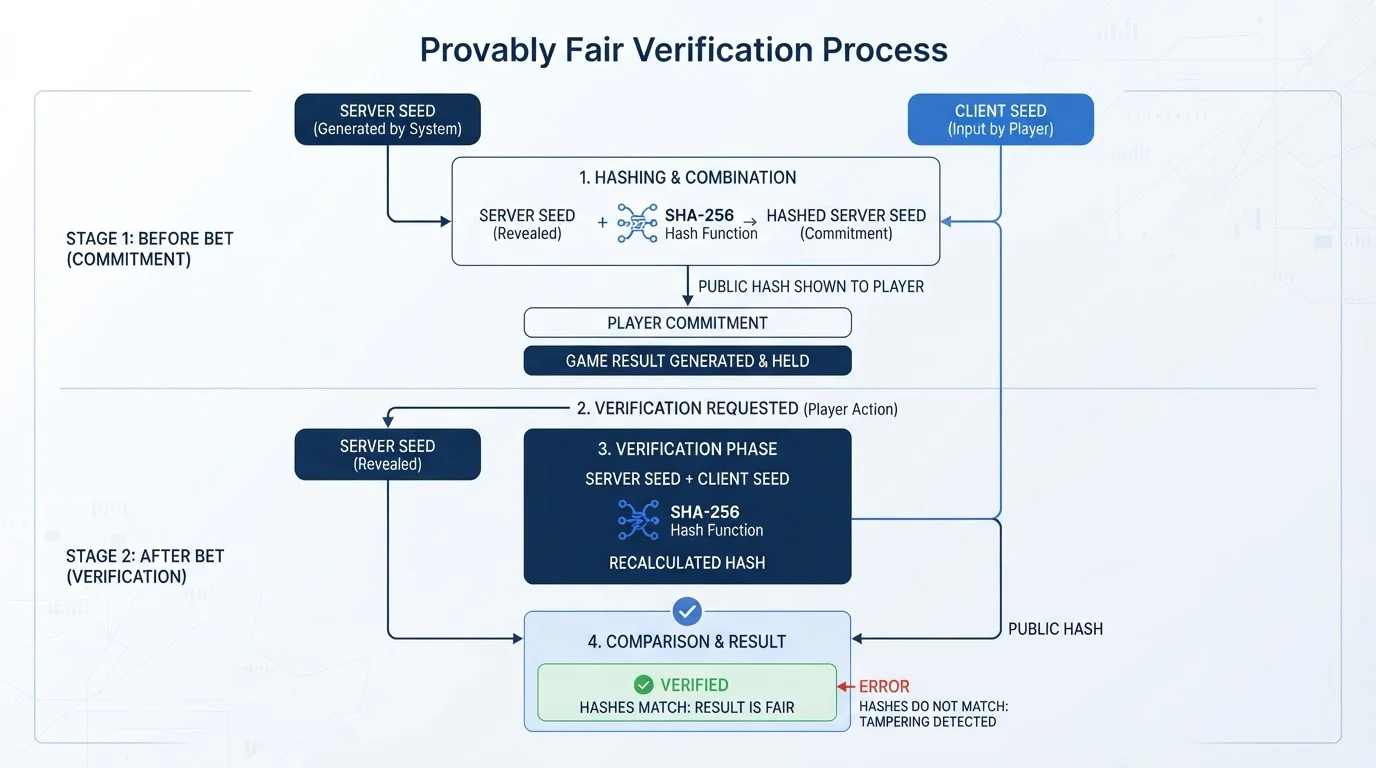
The distinction matters because not every game at a crypto casino is provably fair. Slots from Pragmatic Play rely on Pragmatic’s Malta license and third-party audits. Live dealer games from Evolution rely on Evolution’s multiple licenses and streaming infrastructure. These games are not provably fair in the cryptographic sense. They are audited and regulated, which is a different form of assurance. When you play a third-party provider game at an anonymous crypto casino, you are trusting the provider’s integrity, not verifying it yourself.
For crypto-native provably fair games, verification is straightforward. Most platforms provide a verification tool in the game interface. You enter the server seed, client seed, and nonce (a counter for each bet), and the tool recalculates the outcome. If it matches what the game showed, the outcome was fair. Some platforms integrate this directly into the UI. Others require you to copy the seeds and paste them into an external verifier. The process takes seconds. Most players never do it. But the option to verify is the structural difference between provable fairness and claimed fairness.
The practical takeaway: if you are playing provably fair originals (crash, dice, mines), the game is verifiable, and you should verify at least occasionally to confirm the system works as claimed. If you are playing third-party slots or live dealer games, you are trusting the provider’s licensing and audit, which is the same trust model as a regulated fiat casino. Provably fair does not apply to every game at a crypto casino. It applies to the crypto-native games designed with verification in mind.
How do I verify if a crypto casino game is provably fair?
Check if the game provides server seed, client seed, and a hash before you bet. If it does, the game is provably fair. After the game, the casino reveals the server seed. Use the casino’s verification tool (usually in the game’s settings or help section) or an external provably fair verifier. Enter the server seed, client seed, nonce (bet number), and the tool recalculates the outcome. If it matches what the game displayed, the outcome was not manipulated. Provably fair verification works for crypto-native games like crash, dice, mines, and plinko. It does not work for third-party provider slots (Pragmatic Play, NetEnt) or live dealer games (Evolution). Those rely on provider audits, not player verification. If the game does not show you a server seed hash before you bet, it is not provably fair in the cryptographic sense.
Staying Safe: Operational Security, VPN Use, and Risk Mitigation
Anonymous crypto casinos remove regulatory safeguards. There is no self-exclusion register, no enforced deposit limit, no cooling-off period, no mandatory reality check. You are your own regulator, and the platform is engineered to make regulation difficult. The speed of crypto transactions removes natural friction. There is no wait for a bank transfer, no need to cash out chips, no physical separation between the decision to bet and the bet itself. You are one click away from moving funds at any moment, which is convenient when you want to cash out and dangerous when you want to chase losses.
Operational security starts with compartmentalization. Use a dedicated crypto wallet for gambling and nothing else. Do not reuse the wallet you bought Bitcoin through on a KYC exchange. Do not reuse the wallet you use for legitimate purchases. A dedicated wallet creates separation between your gambling activity and your other on-chain transactions. If that wallet is ever linked to your identity, only your gambling history is exposed, not your entire crypto transaction history.
Use a VPN, but know the platform’s policy on VPN use first. Rollbit explicitly bans VPNs and has documented account freezes and balance confiscations for IP-masking. BC.Game tolerates VPN use but flags accounts for behavioral patterns (timezone mismatches, rapid location changes). BetPanda explicitly allows VPNs. Stake geo-blocks Australia but is widely accessed via VPN with no documented enforcement against individual players. Generic advice to “always use a VPN” is incomplete. The platform’s terms matter. Read them. If VPN use is banned and you use one anyway, you are handing the casino a terms-violation excuse to freeze your account if they ever want one.
Consider browser fingerprinting. Your browser carries identifiers: screen resolution, installed fonts, timezone, language settings, WebGL capabilities, canvas fingerprinting. These create a device signature that can be tracked across sessions even if you change your IP address. For serious operational security, use a dedicated browser profile or virtual machine for gambling. Do not log into personal accounts in the same browser session. Do not use the same device you use for banking or work. This level of compartmentalization is overkill for most casual players, but if anonymity is the priority, your IP address is only one piece of the tracking puzzle.
Set hard limits before you deposit. The platform will not enforce them. You have to enforce them yourself. Decide how much you are willing to lose, fund your gambling wallet with that amount and no more, and when it is gone, it is gone. Do not transfer more. The psychological impact of crypto gambling is different from fiat gambling. Crypto volatility adds a layer of confusion. You might deposit 0.1 BTC worth $6,000, play for an hour, withdraw 0.12 BTC, and lose money in fiat terms if the price of Bitcoin drops 10% during that hour. Track your performance in fiat terms, not crypto terms. Otherwise you will see the satoshis go up and think you are winning while your purchasing power quietly erodes.
Withdraw regularly. Do not let large balances sit in a casino account. Offshore platforms are not banks. They are not insured. They can freeze accounts, demand verification, or disappear overnight. The longer your funds sit on-platform, the longer you are exposed to that risk. Withdraw to your wallet after each session, and cash out to fiat or stablecoins regularly so crypto volatility does not turn a win into a loss.
Do I need a VPN to access anonymous crypto casinos from Australia?
Technically, no. Most platforms are accessible from Australian IP addresses. Practically, yes, for two reasons. First, ACMA has blocked over 1,500 offshore gambling domains via ISP-level DNS blocking. Access a blocked domain without a VPN and you hit a notice page. A VPN or alternative DNS server bypasses that. Second, some platforms (Stake, Rollbit) officially geo-block Australia. A VPN makes you appear to be accessing from an allowed jurisdiction. The catch: some platforms ban VPN use. Rollbit explicitly prohibits it and enforces with account freezes. BetPanda explicitly allows it. BC.Game tolerates it but watches for behavioral flags. Check the platform’s terms before using a VPN. Circumventing a geo-block via VPN can be a terms violation, and if the platform decides to enforce it, your balance is at risk.
Bonuses, Wagering Requirements, and Why “Free” Costs Money
A 200% match bonus up to 10,000 USDT sounds generous until you read the terms. Deposit 5,000 USDT, receive an additional 10,000 USDT in bonus funds, play with 15,000 USDT total. The bonus funds are locked. You cannot withdraw them. You can only bet with them. To convert bonus funds into withdrawable cash, you need to wager them a specified number of times—typically 30x to 60x the bonus amount. A 40x wagering requirement on 10,000 USDT means you must place 400,000 USDT in total bets before the bonus converts to real money.
House edge kills you during that process. Slots typically carry a 3% to 5% house edge. At 3%, wagering 400,000 USDT costs you an expected 12,000 USDT in losses. You started with a 10,000 USDT bonus and lost 12,000 USDT clearing it. You are down 2,000 USDT net. The bonus is not free money. It is a mechanism to lock your deposit into extended play, ensure you wager a large multiple of what you deposited, and extract the house edge over that volume. The math guarantees the casino comes out ahead in aggregate.
Free spins are worse. A “50 free spins” offer typically values each spin at $0.10 to $0.20, so the total value is $5 to $10. Winnings from free spins are credited as bonus funds, subject to the same 30x to 60x wagering requirement. Win $10 from free spins, face a 40x wagering requirement, and you need to wager $400 to convert that $10 into withdrawable cash. With a 3% house edge, expected loss over $400 in wagers is $12. You started with $10 in free-spin winnings and lost $12 clearing the wagering requirement. Free spins are a net-negative proposition in expected value terms.
Cashback bonuses are less predatory but still conditional. A platform offers 10% weekly cashback on net losses. Lose $1,000 in a week, receive $100 back. The catch: the cashback is often credited as bonus funds with a wagering requirement, not as withdrawable cash. Or it is capped at a low percentage of high losses, meaning you have to lose a significant amount to receive a modest rebate. Cashback softens the blow of a losing week, but it does not turn a losing proposition into a winning one.
The smart play is to ignore bonuses entirely. Deposit your own money, play without bonus funds, and withdraw whenever you want. Bonuses chain you to the platform and force you to wager far more than you intended. If you take a bonus, read the terms in full before depositing. Understand the wagering requirement, the time limit to clear it, the games that contribute to it (slots usually contribute 100%, table games often contribute 10% or less), and the maximum cashout limit (some bonuses cap withdrawals from bonus funds even after wagering is complete).
The bonus is not a gift. It is a marketing tool designed to increase your total wagering volume and expose you to the house edge over a larger number of bets. The casino’s generosity is mathematical self-interest. Play without bonuses if you want control over your balance and your withdrawal timing.
New Platforms and the Exit-Scam Risk
A new crypto casino launches every week. They promise better bonuses, faster payouts, more games, lighter KYC. Most will be gone within a year. The ones that survive are the ones with sustainable business models and enough capitalization to cover large wins. The ones that disappear are exit scams: operations designed to collect deposits and vanish.
The pattern is predictable. A new casino launches with aggressive marketing and generous bonuses to attract deposits. For the first few months, everything works smoothly. Withdrawals process quickly. Support is responsive. The platform builds a reputation. As the player base grows and liabilities increase, withdrawals start to slow. Support responses become generic. Small cashouts still process, but large withdrawals get stuck in “manual review.” Eventually, the website goes offline, and the operators disappear with the funds. It happens constantly in this space.
Recognizing the warning signs requires pattern-matching across platforms that have already failed. A brand-new domain with no operational history is the first flag. A team page with stock photos and generic bios (or no team page at all) is the second. Bonus terms that are confusing, contradictory, or impossibly generous are the third. A game library that is suspiciously similar to another platform’s library suggests a white-label operation with low investment. Most critically, a lack of transparency about ownership, licensing, and operational structure means the people behind the platform cannot be identified or held accountable.
Trustpilot and BitcoinTalk are useful but not definitive. New platforms have no reviews yet, and fake positive reviews are cheap to buy. What matters is time. A platform that has operated for six months and processed regular withdrawals without major complaints is less risky than a platform that launched last week. A platform that has operated for two years is less risky than one that launched six months ago. Longevity is not a guarantee of future reliability, but it is a signal that the operation is not a short-term cash grab.
If you choose to use a new platform, keep deposits small and withdraw immediately after wins. Do not let a large balance accumulate on a platform with a short operational history. The excitement of a new casino with a shiny interface and a big welcome bonus is not worth losing your balance to an exit scam. Wait six months. Let other players test it. Watch for payout complaints. If the platform is still operational, processing withdrawals, and responding to disputes after six months, it is safer to trust with a larger deposit. Early adoption in the crypto casino space is a gamble within a gamble.
Mobile Access and Apps
Every platform covered here offers mobile-optimized websites that work in a smartphone browser. Dedicated apps are rare. Stake, BC.Game, and Rollbit offer mobile apps for iOS and Android, but availability depends on jurisdiction. Apple’s App Store does not allow real-money gambling apps in most regions, so iOS apps often require downloading outside the App Store via a profile or web-clip. Android apps are distributed as APKs from the casino’s website rather than through Google Play.
The mobile web experience is typically smoother and safer than sideloaded apps. A mobile browser sandboxes the casino’s code, updates automatically, and does not require granting the casino app-level permissions on your device. A sideloaded APK bypasses Google Play’s security checks and requires you to trust the casino’s code entirely. If the APK is compromised, malicious, or poorly coded, it has access to whatever permissions you granted during installation.
Functionality on mobile web matches desktop for deposits, withdrawals, and most games. Live dealer games work. Slots work. Provably fair originals work. The interface is touch-optimized. The limitation is screen size, not capability. If you prefer an app icon on your home screen, most mobile browsers let you add a web-clip (a shortcut to the casino’s mobile site) that behaves like an app without the security risk of a sideloaded APK.
CoinCasino’s Telegram bot is the exception. It runs inside the Telegram app rather than a browser, which is a genuinely different user experience. You connect your wallet via the bot, and the casino operates within Telegram’s messaging interface. It is unconventional but functional, and Telegram’s sandboxing provides a layer of separation between the casino and your device’s broader permissions.
For most players, mobile web is the right answer. It works, it is safer than sideloaded apps, and it requires no installation or permission grants. If a casino pushes you to download an APK rather than offering a functional mobile website, treat it as a yellow flag. Legitimate platforms invest in mobile-optimized web experiences. Sketchy platforms push APKs because they want deeper device access or because they do not want the scrutiny of an app store.
Responsible Gambling in an Unregulated Environment
Anonymous crypto casinos are structurally designed to maximize play. No self-exclusion register means you cannot lock yourself out across platforms. No enforced deposit limits means the platform will accept whatever you send. No cooling-off periods mean you can deposit, lose, deposit again, and repeat the cycle without a mandatory pause. No reality checks mean the platform will not interrupt your session to remind you how long you have been playing or how much you have lost. Speed removes friction. Crypto transactions settle in minutes. You do not wait for a bank transfer. You do not need to drive to a venue. You are always one click away from depositing more.
The absence of regulation is the entire appeal for privacy-focused players, and it is the entire problem for players who need external constraints to avoid harm. You are your own regulator in a system designed to make regulation difficult. That is not a criticism of the platforms. It is a description of the structure. If you are gambling at an anonymous crypto casino, you are responsible for your own limits, your own exclusion, your own monitoring, and your own intervention when things go wrong. The platform will not do it for you.
Set deposit limits before you start. Fund a dedicated gambling wallet with an amount you are genuinely willing to lose—not an amount you hope to turn into more, but an amount you can afford to lose entirely—and when that wallet is empty, stop. Do not transfer more. The platform will not stop you. Your bank will not stop you. Only you can stop you. If that sounds simplistic, it is because there is no complex solution. External constraints do not exist in this space. Self-imposed constraints are the only tool you have.
Track your performance in fiat terms, not crypto terms. Crypto volatility creates an illusion. You might see your Bitcoin balance increase and feel like you are winning while the fiat value of that balance is decreasing. Convert every deposit and withdrawal to your local currency at the time of the transaction, and track the fiat totals. That is your actual performance. Anything else is noise.
Recognize the warning signs of problem gambling: chasing losses, gambling with money you cannot afford to lose, lying to others about your gambling, neglecting work or relationships to gamble, gambling to escape stress or negative emotions. If you recognize these patterns in yourself, you are past the point where self-imposed limits are likely to work. External help becomes necessary. Gambling Help Online (1800 858 858) is the Australian national service. Lifeline (13 11 14) provides crisis support. Gamblers Anonymous has meetings across Australia. These services exist because self-regulation fails, and when it fails, structured intervention is the path out.
Anonymous crypto casinos offer privacy, speed, and reduced friction. For some players, that is a feature. For others, it is a trap. Know which category you fall into before you deposit. If you have a history of problem gambling, if you have ever chased losses, if you have ever gambled with money you could not afford to lose, anonymous crypto casinos are the worst possible environment for you. The absence of regulation and the speed of transactions turn a bad decision into a catastrophic one in minutes. There is no safety net. The only protection is the decision not to play.
Crypto Casinos Australia 2026 — Bitcoin, Ethereum, USDT, LTC
Content created by the «AussieChips» team
